When students and parents start researching aviation education, one common question comes up again and again:
Should we choose an IATA certificate or an aviation diploma?
Both options are popular and widely discussed, but they serve very different purposes, especially when it comes to industry exposure and real-world aviation readiness. Understanding this difference is essential before making a decision.
Before comparing the two, it’s also important to clearly understand what IATA certification actually represents. Many students and parents in Kochi, Kerala, and Bangalore have common misconceptions about its role in aviation education, which are explained in detail in our blog on IATA Certification: What Students and Parents in Kochi, Kerala & Bangalore Commonly Misunderstand.
Understanding the Two Options Clearly
Before comparing industry exposure, it’s important to understand what each option actually offers.
What Is an IATA Certificate?
An IATA certificate is a short-term, subject-focused program developed by the International Air Transport Association. These courses mainly concentrate on specific airline-related topics.
Common focus areas include:
Airline ticketing
Fare calculation
Reservations systems
Airline documentation
IATA certification is largely theory-based and knowledge-oriented.
What Is an Aviation Diploma?
An aviation diploma is a structured, institute-based program offered by a professional aviation academy, designed to prepare students for various areas of the aviation industry. These programs focus on both theoretical understanding and practical exposure, making them ideal for students who want a clear introduction to aviation careers
It usually includes:
Airport operations fundamentals
Passenger handling procedures
Customer service training
Communication and grooming
Industry-oriented practical learning
The focus is on overall aviation exposure, not just one function.
Industry Exposure: The Key Difference
Industry Exposure with an IATA Certificate
IATA certification offers:
Strong theoretical understanding of airline systems
Global-standard course material
Knowledge useful for ticketing and travel-related roles
However, it has limited industry exposure because:
No direct airport handling training
Minimal focus on soft skills and customer interaction
No exposure to real airport work environments
It prepares students academically, but not fully for day-to-day aviation operations.
Industry Exposure with an Aviation Diploma
An aviation diploma focuses heavily on practical and industry-aligned exposure, such as:
Understanding airport workflows
Passenger service scenarios
Professional communication standards
Aviation-specific etiquette and grooming
Realistic training aligned with airport roles
Students gain a broader understanding of how the aviation industry functions, not just one segment.
Classroom Learning vs Real-World Readiness
IATA Certificate
Primarily classroom or online-based
Focused on concepts, rules, and systems
Suitable for theory-driven learning
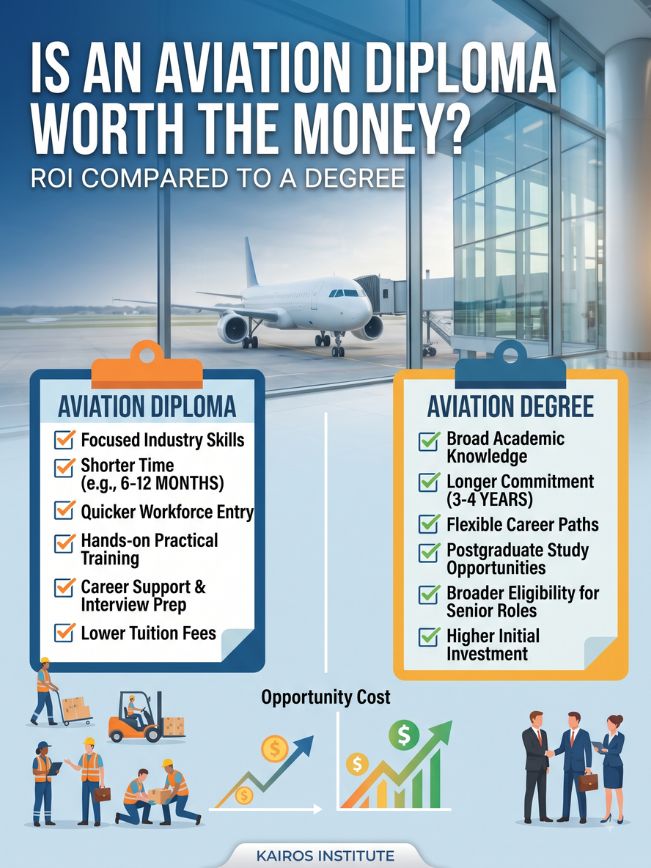
Aviation Diploma
Classroom + practical training
Emphasis on applied skills
Designed to make students industry-ready
When it comes to industry exposure, aviation diplomas generally offer more hands-on learning.
Which One Is Better for Beginners?
For students who are:
An aviation diploma provides:
IATA certification may feel too narrow or theoretical for beginners without prior industry understanding.
Can IATA Certification and Aviation Diploma Work Together?
Yes — but in the right order.
A common and effective approach is:
Start with an aviation diploma to understand the industry
Gain practical exposure and confidence
Add IATA certification later if specialized knowledge is required
This way, IATA becomes an enhancement, not a replacement for industry exposure.
What Do Recruiters Value More?
While requirements vary by role, recruiters generally look for:
These qualities are developed more effectively through aviation diploma training than through theory-only certification.
Making the Right Choice as a Student or Parent
Instead of asking “Which certificate sounds better?”, it is more useful to ask:
Will this course help me understand real aviation work?
Does it build communication and professional skills?
Does it prepare me for industry expectations?
For industry exposure, aviation diplomas usually offer more practical value.
So
Both IATA certificates and aviation diplomas have their place — but they are not the same.
Understanding this difference helps students and parents avoid confusion and choose a path that truly supports long-term growth in aviation.