Fifteen laureates were awarded in 2019, for achievements that have conferred the greatest benefit to humankind.
Their work and discoveries range from how cells adapt to changes in levels of oxygen to our ability to fight global poverty.
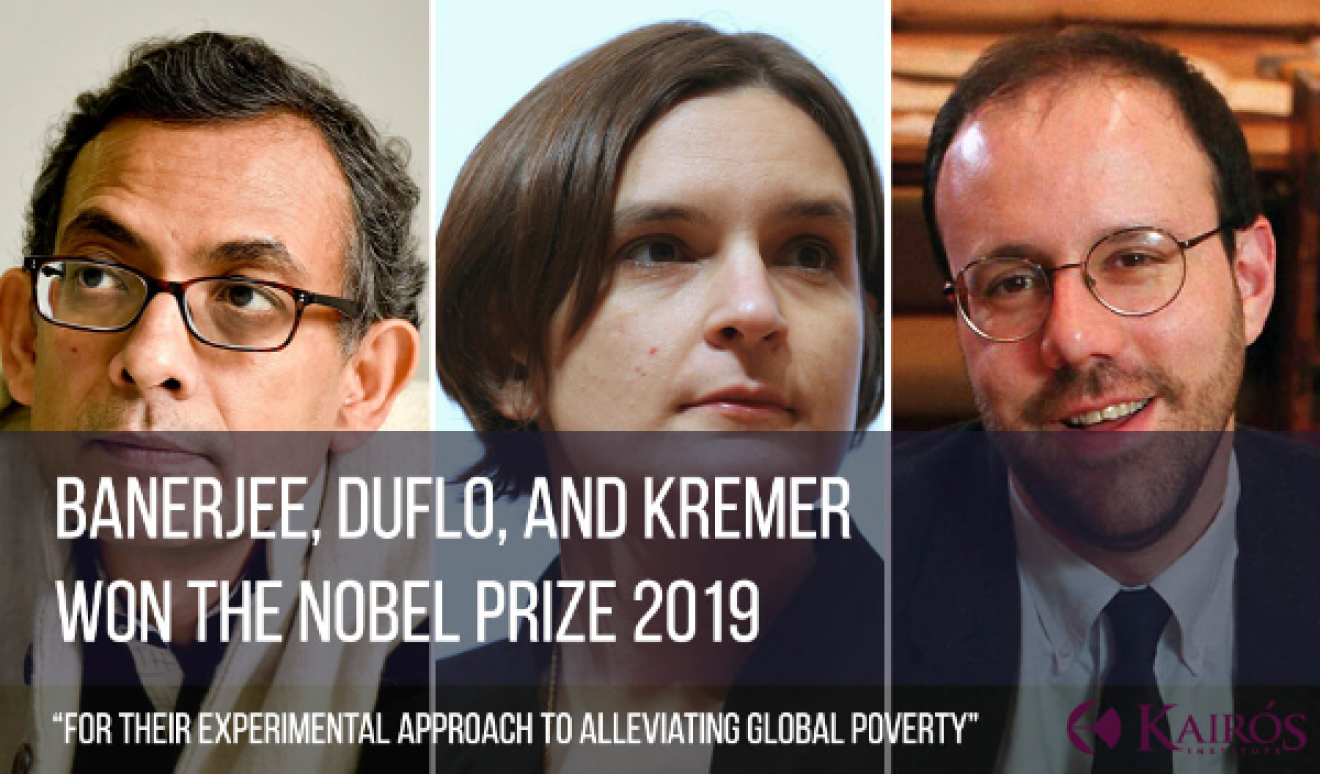
The 2019 Prize in Economic Sciences in Memory of Alfred Nobel has been awarded to Abhijit Banerjee, Esther Duflo and Michael Kremer for their“Experimental approach to alleviating global poverty”.They were rewarded for their contributions to the importance of development economics and the innovative approaches and theories developed by the economists.
The major contribution of Banerjee, Duflo, and Kremer was on the approach to tackle poverty -- in the fast-growing area of development economics. They made a scientific framework and used hard data in order to identify the reasons behind poverty, finding out the effects of several policies and analysing its cost effectiveness. They developed a Randomised Control Trials (RCT) to do this. They evaluated different policies in action to identify the best one. Initially they started with education and then expanded to health, credit and agriculture. Banerjee and Duflo explains the importance of market imperfections and government failures in framing policies. These economists make significant initiative in applying these finding in different contexts. Their work established great evidence in fighting against poverty in many developing countries.
Our approach is to unpack the problems one by one, and examine them as scientifically as possible - understanding the deep, interconnected roots of poverty.
The key to their research is to take the daunting issue of global poverty, and break it down into smaller questions -- which can be more credibly answered.
For example, to find ways to improve children health you would examine various experimental approaches, such as education methods, health systems, agricultural approaches, and access to credit.
Despite recent dramatic improvements, one of humanity’s most urgent issues is the reduction of global poverty, in all its forms. More than 700 million people still subsist on extremely low incomes. Every year, around five million children under the age of five still die of diseases that could often have been prevented or cured with inexpensive treatments. Half of the world’s children still leave school without basic literacy and numeracy skills.
This year’s Laureates have introduced a new approach to obtaining reliable answers about the best ways to fight global poverty. In brief, it involves dividing this issue into smaller, more manageable, questions – for example, the most effective interventions for improving educational outcomes or child health. They have shown that these smaller, more precise, questions are often best answered via carefully designed experiments among the people who are most affected.
In the mid-1990s, Michael Kremer and his colleagues demonstrated how powerful this approach can be, using field experiments to test a range of interventions that could improve school results in western Kenya.
Abhijit Banerjee and Esther Duflo, often with Michael Kremer, soon performed similar studies of other issues and in other countries. Their experimental research methods now entirely dominate development economics.
The Laureates’ research findings – and those of the researchers following in their footsteps – have dramatically improved our ability to fight poverty in practice. As a direct result of one of their studies, more than five million Indian children have benefitted from effective programmes of remedial tutoring in schools. Another example is the heavy subsidies for preventive healthcare that have been introduced in many countries.
These are just two examples of how this new research has already helped to alleviate global poverty. It also has great potential to further improve the lives of the worst-off people around the world.
The impact created by Banerjee, Duflo and Kremer’s approach has started less than two decades. Duflo is the youngest economics Nobel prize winner. She is also only the second woman to be awarded the Nobel prize.
_
Prepared by
Veena Vinod
Faculty
Kairos Institute, Thodupuzha