What Is Virtual Reality Training in Aviation? How Kairos Institute Uses VR for Student Learning
Admissions Started
Book your seat Now!
- AIRPORT MANAGEMENT
- LOGISTICS & SUPPLY CHAIN MANAGEMENT
- HOSPITAL ADMINISTRATION
- DIPLOMA & PG DIPLOMA
- 6 MONTHS & 1 YEAR
Imagine stepping into a fully operational airport — walking the terminal floor, operating a check-in counter, loading baggage onto an aircraft, or performing a cabin safety drill — all without leaving your classroom in Kochi or Bangalore. This is not a hypothetical future. It is how students at Kairos Institute train today.
Kairos Institute is the first aviation training institute in India to build and integrate its own proprietary Virtual Reality (VR) platform into aviation and logistics training — a fully immersive virtual airport environment developed entirely in-house. This blog explains what VR training in aviation actually means, why it matters, and how Kairos uses its own technology to give students in Kerala and Bangalore a measurable edge in the job market.
What Is Virtual Reality (VR) Training in Aviation?
Virtual Reality (VR) training in aviation is the use of immersive, computer-generated environments to simulate real airport and aircraft scenarios for professional learning. Instead of reading about a check-in procedure or watching a video, trainees put on a VR headset and physically perform the task inside a virtual airport — making decisions, correcting mistakes, and repeating procedures until they are job-ready.
VR in aviation covers ground handling, cabin crew training, airport operations, cargo management, and passenger services — the full spectrum of roles that Kairos students are trained and placed into.
Why Aviation Training Specifically Benefits from VR
Aviation is one of the few career fields where a mistake during training carries real consequences once transferred to a live airport environment. A ground staff member who mishandles baggage loading, or a cabin crew member who forgets an emergency procedure sequence, creates operational risk the moment they join an airline.
Traditional training addresses this through physical infrastructure: mock cabins, practice counters, role-play scenarios. But physical setups are limited by space, availability, and cost. Students can only practise at certain times, in certain locations, and a mistake often disrupts the entire class.
VR solves this systematically:
Any scenario can be repeated instantly, as many times as needed, with zero disruption
Students experience realistic consequences — virtual passenger complaints, missed procedures — without real-world risk
Trainers can observe exactly where each student makes errors, enabling precision feedback
Training extends beyond classroom hours through cloud-based access to recorded modules
As Aerospace Global News (February 2026) reported, 2026 is shaping up to be a pivotal year for VR in aviation training globally — with AI-powered debriefing, VR preparation tools, and data-driven assessment becoming embedded architecture rather than optional enhancements across airlines and training providers worldwide. Read the full report
The Research Behind VR Learning Outcomes — 2025 & 2026 Data
The case for VR in professional training is not based on novelty. It is backed by measurable, peer-reviewed outcomes — with aviation emerging as one of the highest-impact sectors.
Peer-Reviewed Study — Journal of Interdisciplinary Perspectives (2025)
A peer-reviewed study evaluated VR effectiveness across 100 aviation students. Post-training competency scores reached a mean of 87.6% compared to a pre-training mean of 65.4% — a statistically significant improvement. Additionally, 92% of students reported increased motivation and 94% reported improved focus and immersion during VR-based learning. Read the full study
Frontiers in Virtual Reality (2026)
A 2026 peer-reviewed study published in Frontiers in Virtual Reality found that students who trained using VR achieved significantly higher scores in their first real flight compared to the control group trained through traditional classroom methods. The study supports VR as a valuable tool for enhancing practical skill acquisition and spatial awareness in aviation training. Read the full study
VR Training Statistics 2026 — Takeaway Reality
According to VR training research updated in January 2026:
Metric | Outcome |
Knowledge retention after 1 year — VR vs classroom | 80% vs ~20% |
Increase in learning effectiveness vs traditional methods | 76% |
Reduction in training time across VR-using industries | Up to 75% |
Cost parity with classroom training was reached at | 375 learners |
Cost advantage of VR with 3,000 learners | 52% more cost-effective |
View full VR training statistics 2026
HQ Software Lab — VR in Aircraft Training (March 2026)
Research cited in March 2026 shows that VR can accelerate the learning process up to 4 times by providing risk-free, repeatable practice opportunities. The same research notes that VR integration in aviation has the potential to reduce training time by up to 50% and can boost hands-on confidence by up to 275%. Read the full report
How the World's Leading Airlines Are Using VR — 2025 Real-World Evidence
Kairos Institute did not invest in VR training as a marketing exercise. The decision was grounded in what the world's most successful airlines were already doing — and what the evidence was clearly showing.
Lufthansa — 20,000 Flight Attendants Trained Annually in VR
Lufthansa Aviation Training (LAT) has trained its cabin crew using VR since 2019 — with approximately 20,000 Lufthansa flight attendants completing annual VR training every year. The programme was the first VR training approved by the German Federal Aviation Authority and won the German Excellence Award 2020 in Training & Education.
In November 2025, Lufthansa extended this programme further — partnering with PACE Aerospace to develop a digital twin of the Airbus A320neo cabin powered by VR, specifically for emergency evacuation and safety procedure training aligned with ICAO standards. Read the 2025 Lufthansa VR development
Brussels Airlines — VR Replaces Traditional Pilot Training Devices (July 2025)
In July 2025, Brussels Airlines became the first airline within the Lufthansa Group to use VR as a replacement — not merely a supplement — for traditional training devices in A320 type rating. Pilots completed a part of their official type rating using a VR-based solution within an authority-approved training programme, without instructor supervision. This marks a turning point: VR is no longer supplementary — it is now a primary training method for a certified European airline. Read the Brussels Airlines VR announcement
Embry-Riddle Aeronautical University — 30% Reduction in Time to Solo Flight
Embry-Riddle Aeronautical University, one of the world's top aviation universities, reduced the time before a student could fly solo by 30% after integrating VR into its private pilot training curriculum. Source — HigherEchelon, AR and VR in Aviation Training
Global VR in Aerospace Market — $17.86 Billion by 2030
Spending on VR and AR technologies across the aviation industry reached an estimated $1.76 billion in 2023 and is projected to reach $17.86 billion by 2030 — a tenfold increase that reflects how central VR is becoming to airline and airport operations globally. Source — HQ Software Lab, March 2026
Kairos's Proprietary VR Platform — Built In-House, Built for Indian Aviation
What separates Kairos Institute from every other aviation training institute in India is this: Kairos built its own Virtual Reality training platform.
This is not an off-the-shelf tool adapted for aviation. Kairos's VR environment was designed and developed entirely in-house — built specifically around the operational realities of Indian airports and the exact job roles Kairos students are placed into.
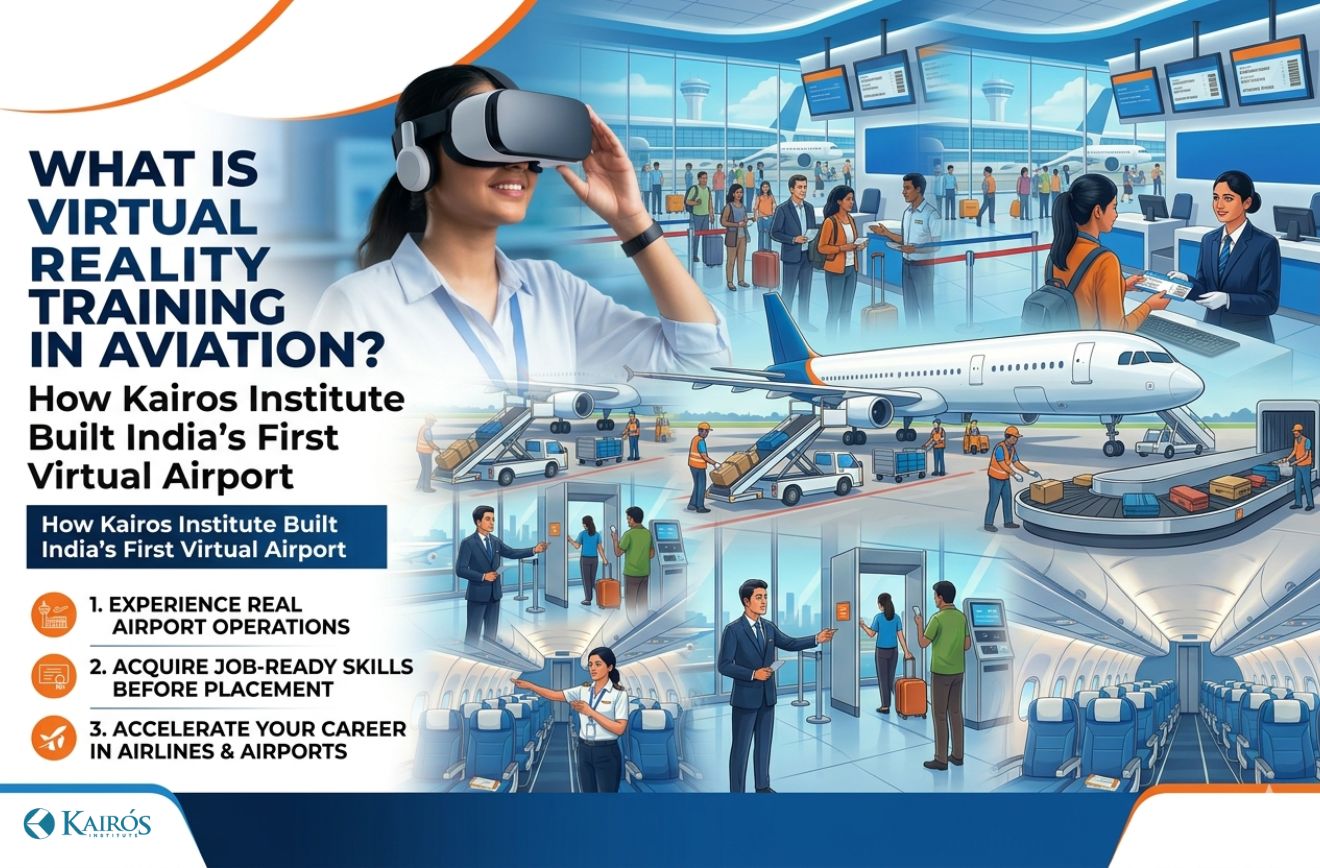
The platform simulates a full-scale operational airport environment — including terminals, check-in counters, boarding gates, airside zones, cargo areas, ramp operations, and aircraft cabins. Students are not watching a walkthrough. They are inside the environment, performing tasks in real time.
What the Kairos VR Platform Includes
A Full Virtual Airport Environment The VR environment replicates the layout, workflow, and operational scale of a working Indian airport. Students develop spatial familiarity with terminal zones, restricted areas, airside vs landside boundaries, and passenger flow sequences — before their first real shift.
Scenario-Based Training for Real Job Situations Rather than theory modules delivered passively, the platform places students in realistic, high-pressure scenarios: a delayed flight, a passenger with a baggage dispute, an emergency evacuation drill, a cargo documentation discrepancy. Each scenario replicates what actually happens on shift — building instinct, not just knowledge.
AR, VR, and MR — Extended Reality in One System The platform uses a combination of Augmented Reality (AR), Virtual Reality (VR), and Mixed Reality (MR) — together classified as Extended Reality (XR). Students use full VR immersion for complex operational drills and AR overlays for equipment identification and procedure walkthroughs, within one integrated system.
Cloud-Based Access — Train Beyond Classroom Hours The platform is cloud-delivered, meaning students are not limited to a single lab session. Training modules, assessments, and scenario replays are accessible beyond timetabled hours — a significant advantage for students commuting from Thodupuzha, Thrissur, or Kollam to Kochi.
AASSC-Aligned Training Standards Training content is aligned with the Aerospace and Aviation Sector Skill Council (AASSC) — the government-backed body setting national occupational standards for India's aviation sector. AASSC-aligned training is directly recognised by airlines and airport operators during hiring. Visit AASSC
What Students Practise Inside Kairos VR — Module by Module
1. Passenger Check-In Simulation
Students operate a virtual airline check-in counter, processing passenger bookings, verifying documents, issuing boarding passes, and handling excess baggage. The simulation includes real-world complications: passengers with invalid documents, overbooked flights, and last-minute seat change requests.
2. Boarding Gate Operations
Students manage virtual boarding queues, make gate announcements, handle boarding priority sequences, and manage late passenger situations within departure windows.
3. Passenger Handling & Customer Service
Students interact with virtual passenger personas — ranging from cooperative to difficult — developing communication, conflict resolution, and service recovery skills tested directly in airline recruitment.
4. Cargo Documentation & Handling
Students process virtual air cargo documentation, including airway bills, customs declarations, and dangerous goods identification — core skills for the Diploma in Air Cargo Management.
5. Airport Emergency Response
Students experience simulated airport emergencies — medical incidents, security alerts, flight delays — learning correct communication protocols, escalation procedures, and passenger management responses required in real situations.
6. Ramp & Ground Handling Operations
Students navigate airside zones, understand ramp safety rules, practise baggage loading sequences, and operate virtual ground support equipment — preparing specifically for ground handling and airport handling roles.
7. Terminal Navigation & Zonal Familiarity
Students learn airport zoning (airside vs landside, restricted vs public areas), understand passenger flow through checkpoints, and develop spatial familiarity that typically takes new airport employees weeks to build in real environments.
VR Training vs Traditional Training — Side-by-Side Comparison
Training Element | Traditional Classroom | Kairos VR Platform |
Airport environment | Described verbally or shown in photos | Experienced inside a full-scale virtual airport |
Check-in practice | Role-play with classmates | Real-time interaction at virtual workstations |
Emergency procedures | Theory from manual | Scenario-based drills in virtual cabin or terminal |
Ground handling equipment | Diagrams and videos only | Hands-on operation of virtual ground support equipment |
Mistakes and retries | Difficult to redo in physical setup | Repeat any scenario instantly, zero consequences |
Knowledge retention | ~20% after 2 weeks | Up to 80% after 1 year |
Accessibility | Fixed classroom, fixed hours | Cloud-based, accessible beyond scheduled sessions |
Retention data: Takeaway Reality, VR Training Statistics 2026. View source
Which Aviation Roles Does Kairos VR Training Prepare You For?
Aviation Role | What VR Simulates | Skills Developed |
Ground Staff / Ramp Agent | Aircraft push-back, baggage handling, safety zones | Spatial awareness, safety protocols, equipment operation |
Check-in & Boarding Agent | Passenger counters, gate boarding flow | PNR handling, passenger communication, urgency management |
Cabin Crew | In-flight service, emergency drills, galley operation | Safety procedures, service delivery, crisis response |
Airport Operations Coordinator | Airside movement, terminal management | Workflow coordination, compliance, multi-tasking |
Cargo Handling Agent | Cargo terminal, documentation, loading | IATA cargo codes, hazmat awareness, load planning |
Why This Matters Now — India's Aviation Job Demand in 2026
The urgency of job-ready aviation training in India has never been greater.
India is currently the world's third-largest domestic aviation market — a position it secured in 2024, surpassing the United Kingdom. The number of operational airports grew from 74 in 2014 to 163 airports in 2025, with the government's Vision 2047 targeting 350–400 airports by the time India marks its centenary of independence. The aviation sector currently supports 7.7 million jobs in India and contributes USD 53.6 billion to the national economy. By 2040, total aviation employment is projected to reach 25 million. Source — PIB India, Aviation Vision 2047
Passenger traffic is forecast to grow 7–10% in FY2026, reaching 175–181 million domestic passengers. Source — Indian Aviation Statistics
But growth without talent is friction. As Aviation Indeed's 2026 hiring outlook noted in January 2026: "The aviation industry does not suffer from lack of interest — it suffers from lack of job-ready talent. Employers are not just looking for certificates." Read the Aviation Indeed 2026 hiring report
This is precisely the gap Kairos's VR training addresses — students who graduate not just certified, but genuinely prepared.
Gamification: Why Kairos Believes Learning Should Be Engaging
Kairos Institute's approach to VR is grounded in a specific educational philosophy: students learn best when learning is engaging, goal-driven, and genuinely enjoyable. Within the VR platform, this is applied through gamification:
Students earn achievements and progress through levels as they complete modules
Performance metrics are tracked — students see their own improvement in real time
Competitive elements encourage effort without creating anxiety
Real-time feedback replaces the delayed correction cycle of traditional assessments
The result is a training experience where a Plus Two fresher from Kerala or a career switcher from Bangalore is genuinely motivated to log in, complete modules, and repeat difficult scenarios — not because they are required to, but because the platform makes progress feel rewarding.
Which Kairos Courses Include VR Training?
VR training at Kairos is integrated across programmes — not an optional module:
Course | How VR Is Used |
Diploma in Airline & Airport Management (12 months) | Check-in, boarding, gate operations, passenger management |
Diploma in Cabin Crew Management (12 months) | In-flight service, emergency drills, passenger interaction |
Diploma in Airport Handling (6 months) | Ramp operations, baggage handling, ground equipment |
Diploma in Passenger Management (6 months) | Passenger flow, special assistance, conflict resolution |
Diploma in Air Cargo Management (6 months) | Cargo documentation, dangerous goods, warehouse simulation |
BBA with Aviation (3 years) | Comprehensive use across operational and management modules |
MBA with Airline & Airport Management (2 years) | Crisis management, terminal planning, airline operations |
Frequently Asked Questions
What makes Kairos Institute's VR training different from other aviation institutes in India?
Kairos Institute built its own proprietary Virtual Reality training platform — designed entirely in-house for Indian aviation education. No other vocational aviation training institute in India has built and integrated its own VR system into its core curriculum. Other institutes may use physical mock counters or airport observation visits. Kairos students train inside a full virtual airport environment from day one.
Do I need a VR headset to train at Kairos?
The VR platform uses headsets and extended reality hardware provided at Kairos campuses. Certain modules are also accessible via cloud delivery, extending training beyond fixed lab sessions.
Will VR training actually help me get a job at an airline?
Yes. Airlines recruit for readiness, not just qualifications. A Kairos student who has completed hundreds of virtual shift simulations arrives at a recruitment drive with practised instincts — not just textbook recall. The Journal of Interdisciplinary Perspectives (2025) found VR-trained aviation students demonstrated significantly higher competency scores and task accuracy than traditionally trained peers. Read study
Is VR training available at Kairos Bangalore as well as Kochi?
Yes. Kairos's VR-integrated training is available across all campuses — Kochi (Kakkanad), Thodupuzha, and Bengaluru (Koramangala). Cloud-based delivery ensures the same platform quality and content across all locations.
Is VR training a replacement for real airport visits?
No. VR training at Kairos complements industrial visits and airport exposure — it does not replace them. The platform gives students repeatable, pressure-tested practice so that when they visit or join a real airport, they arrive with familiarity rather than starting from zero.
How does VR training help in airline interviews?
Airline recruiters ask situational questions — how would you handle an overbooked flight, what do you do if a passenger's documents are invalid? Kairos students have physically practised these exact scenarios in VR. Their answers in interviews are confident, specific, and grounded in practised experience.
Final Thought: The Gap Between Training and Job-Readiness Is Closing — But Only at Some Institutes
India's aviation sector is targeting 163 airports in 2025, growing to 350–400 airports by 2047, with 25 million aviation jobs projected by 2040. The demand for work-ready aviation professionals has never been higher — and the gap between "trained" and "job-ready" is where most institutes fall short.
VR training is not a gimmick. It is a scientifically validated, globally adopted methodology that produces measurably better outcomes than passive classroom learning. Kairos Institute's decision to build and integrate its own proprietary VR platform into its core curriculum is a direct response to what airlines and airports actually need from new recruits.
If you are evaluating aviation institutes in Kerala or Bangalore and want to understand not just what they teach, but how they teach it — that question matters enormously for your career outcomes.
Kairos is ready to walk you through the VR experience before you even enrol.
Want to Experience Kairos VR Training Before You Enrol?
WhatsApp Us: +91 80 780 290 50 | kairosinstitute.in
📍 Kochi: Divine Park Layout Road, Kakkanad, Ernakulam — 682 037 📍 Bangalore: #A7, KHB Colony, 5th Block, Koramangala — 560 095 📍 Thodupuzha: Kalarickal Bazar, Near Private Bus Stand, Idukki — 685 584
Popular Blogs
What Certifications Should Your Aviation Institute Have? A Complete Guide for Students and Parents in Kerala
Read More


How AI and Automation Are Changing Airport Jobs in 2026 — and What It Means for Your Career
Read More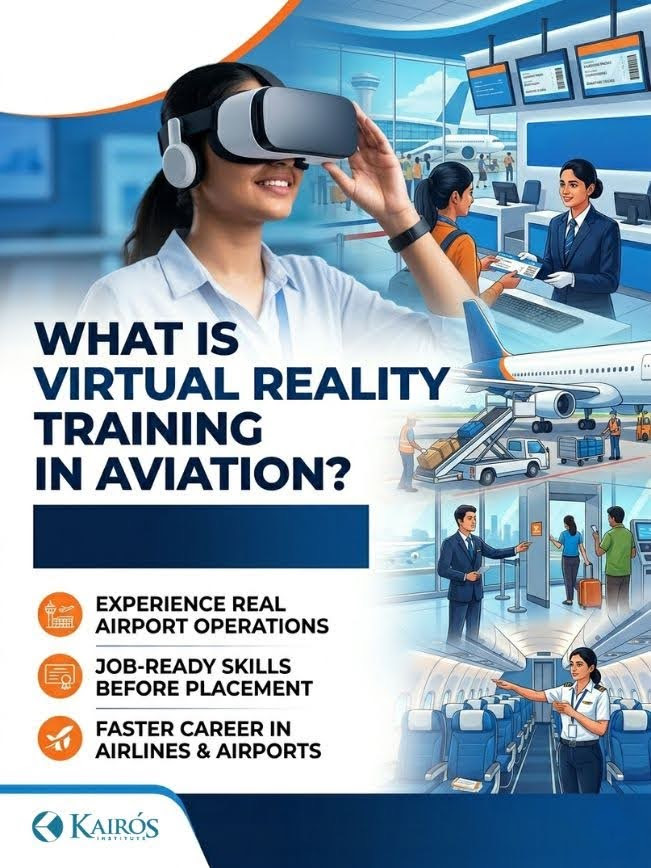
What Is Virtual Reality Training in Aviation? How Kairos Institute Uses VR for Student Learning
Read More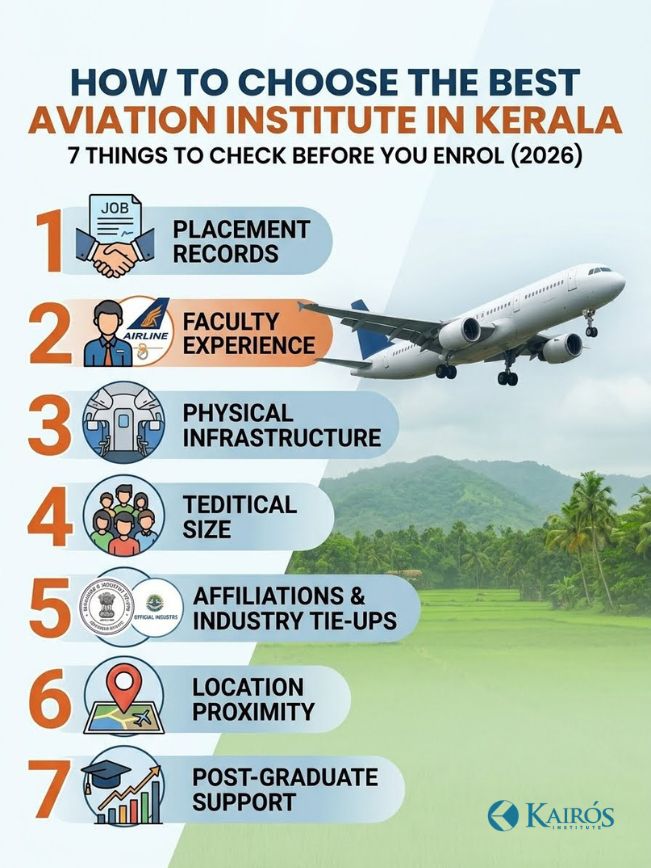
How to Choose the Best Aviation Institute in Kerala — 7 Things to Check Before You Enrol (2026)
Read More