The aviation industry is changing faster than at any point in its history. Airports around the world are deploying artificial intelligence, biometric systems, and automation technology at a scale that was unimaginable just five years ago. And for students considering a career in aviation, this raises one very natural question — are airport jobs still a safe bet?
The honest answer is yes. But the nature of those jobs is shifting. Students who understand what is changing — and prepare accordingly — will find themselves in one of the most in-demand workforce segments in India today.
As a leading aviation institute in Kerala with branches in Kochi, Thodupuzha, and Bangalore, Kairos Institute prepares students for the version of the aviation industry that exists today — not the version from a decade ago. This guide explains exactly what technology is changing, which roles are growing, what skills now matter most, and what all of this means for you.
What Is Actually Changing at Airports Right Now?
Before assuming the worst, it helps to understand what AI and automation are actually being used for at airports in 2026.
The shift is not about robots replacing ground staff. It is about moving airport operations from reactive to predictive — using technology to handle high-volume, repetitive tasks so that human professionals can focus on what requires judgment, communication, and real-time decision-making.
Real changes happening at airports right now include:
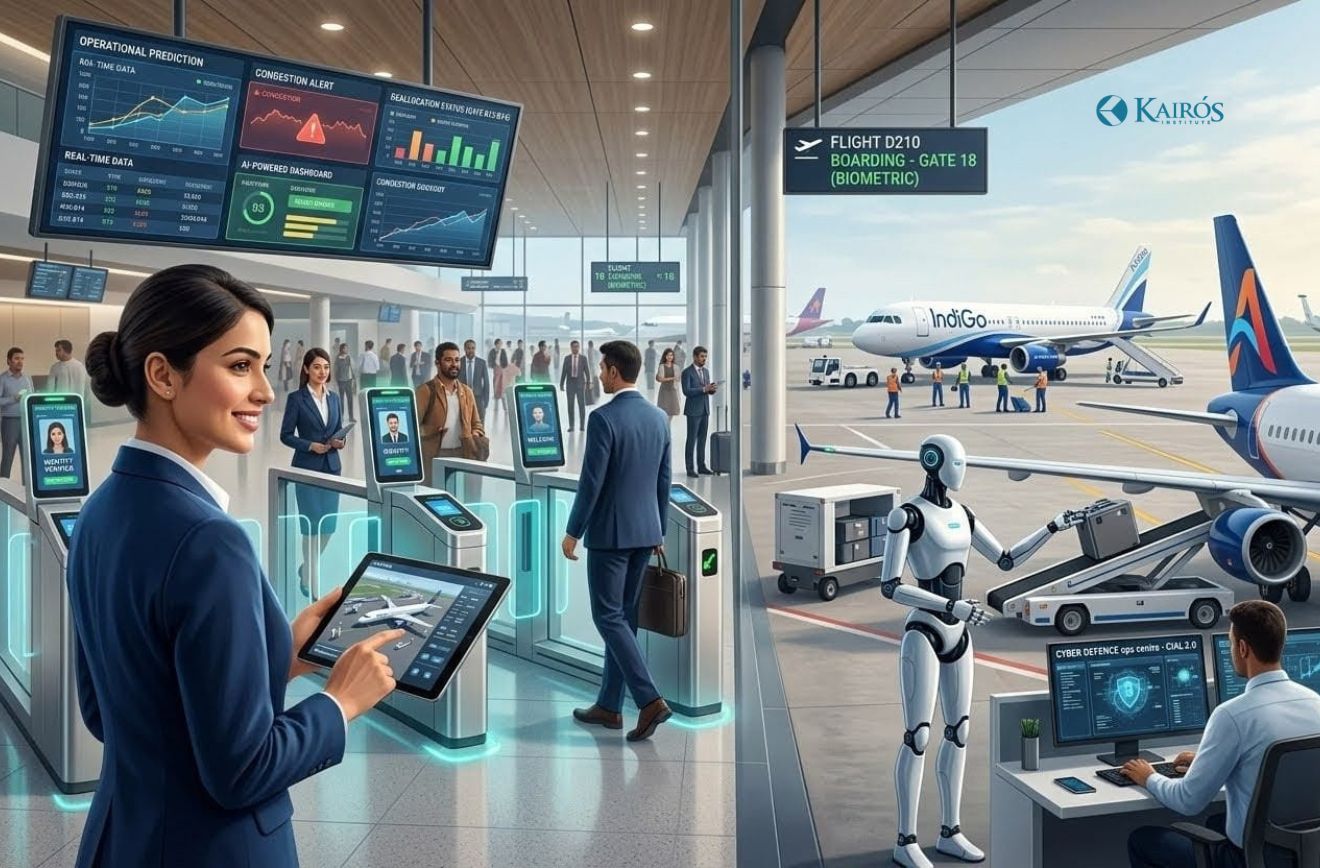
AI-powered operations centers that predict security checkpoint congestion up to 20 minutes in advance and automatically reallocate resources before queues form
Biometric identity systems replacing boarding passes, allowing passengers to move from check-in to boarding using facial recognition alone
Automated baggage screening lanes with AI tray tracking that reduce manual handling and speed up security processing
Digital twin technology — virtual replicas of entire airport infrastructure — used to simulate disruptions and test solutions before they affect real passengers
Humanoid robots being trialled for baggage handling at airports like Tokyo Haneda, directly in response to labour shortages on the ramp
Closer to home, Cochin International Airport launched CIAL 2.0, a Rs 200-crore digital transformation initiative that introduced over 4,000 AI-powered surveillance cameras, automated baggage screening, full-body scanners, biometric smart immigration gates, and India's first dedicated airport Cyber Defence Operations Centre — all currently operational.
These are not future plans. They are already running at airports where Kairos alumni work today.
Are Airport Jobs Actually Disappearing?
This is the most important question to answer clearly, because a lot of career advice avoids it.
The data does not support the idea that automation is eliminating airport jobs. In fact, the opposite problem exists — airports are facing serious labour shortages, not surpluses.
Here is what the evidence shows:
The president of GMO AI and Robotics — one of the companies building humanoid airport robots — publicly acknowledged that "while airports appear highly automated, their back-end operations still rely heavily on human labour and face serious labour shortages"
Humanoid baggage-handling robots being trialled at Tokyo Haneda can currently operate for only two to three hours before needing to recharge — airports run 24 hours a day
The United States Congress passed an aviation safety bill in early 2026 requiring at least two qualified pilots on every commercial flight deck, reinforcing that human oversight is legally mandated even as AI tools expand
Indian airports including CIAL, Bangalore's Kempegowda International, and Thiruvananthapuram International are all mid-expansion — each creating more operational roles, not fewer
The more accurate picture is this: automation is absorbing repetitive, high-volume processing tasks. It is simultaneously creating demand for people who can supervise, interpret, and work alongside these systems. The workforce is not shrinking. It is shifting upward in skill requirement.
Which Airport Roles Are Evolving — and Which Are Growing?
Understanding which roles are changing helps students prepare for the right version of this industry.
Roles being assisted by automation:
Check-in and baggage drop — self-service kiosks now handle routine processing; staff focus on exceptions, accessibility assistance, and passenger service
Security screening — automated lanes with AI tracking reduce manual tray handling; human officers focus on anomaly resolution and escalation
Baggage loading — autonomous ground vehicles are being tested on ramps; human operators oversee these systems remotely from central dashboards
Roles that are evolving and growing in value:
Airport operations supervisors — now work with live AI dashboards, interpret real-time data, and make decisions the system cannot
Customer relations and passenger experience staff — more critical than ever; empathy, conflict resolution, and communication are things no system replicates
Cargo and freight professionals — AI-driven flow prediction and digital traceability tools are standard; freight staff need digital literacy alongside operational knowledge
Brand new roles being created by technology:
Biometric systems operators — managing smart immigration gates and facial recognition platforms
AI surveillance coordinators — overseeing intelligent camera networks and responding to flagged incidents
Cybersecurity operations staff — CIAL's new Cyber Defence Operations Centre is one of the first of its kind at an Indian airport and requires dedicated personnel
The pattern across all three categories is consistent: roles that involve repetitive physical processing are being assisted. Roles that involve passenger interaction, system oversight, and judgment are growing. Students who train for the evolved version of these roles will find themselves ahead of candidates who have not.
What Skills Do Employers Actually Look for Now?
The skills aviation recruiters evaluate have shifted meaningfully. These are the five that consistently appear in 2026 hiring criteria.
1. Operational Awareness
Understanding how airport systems connect — how a gate change affects ground handling, which affects catering, which affects the next departure — is something AI tools support but cannot replace. Professionals who can read a situation across departments and anticipate downstream effects are valued above those who can only execute within a single role.
2. Digital Literacy
You do not need to be a software engineer. But you do need to be comfortable working with dashboards, tracking platforms, biometric systems, and real-time data tools. Airports deploying AI surveillance networks and smart immigration systems — like CIAL right now — need staff who can work alongside these technologies confidently from day one.
3. Passenger-Facing Communication
This remains the largest gap between what automation delivers and what passengers actually need. Airlines treat passenger experience as a competitive differentiator, and the staff who manage difficult situations — delays, diversions, distressed travellers, accessibility needs — are genuinely irreplaceable. This skill is trainable, but only through practice in realistic scenarios.
4. Adaptability and Multi-Role Competency
Airlines are actively seeking candidates who can grow with the organisation as roles evolve. A professional who can absorb new tools and new responsibilities without needing to restart their career is far more valuable to a recruiter than a specialist locked into one task. Adaptability is partly mindset, but it is built through training programs that expose you to more than one part of the operation.
5. Knowledge of Aviation Regulations and Safety Standards
This is the one area where AI is explicitly not trusted to make final decisions. Safety, compliance, and regulatory adherence require human accountability. Candidates who arrive with working knowledge of ICAO standards, DGCA regulations, and IATA procedures immediately signal credibility to recruiters. This knowledge cannot be picked up on the ramp — it needs structured preparation.
What Does This Mean for Students in Kerala and Bangalore?
The global transformation of airports is not arriving someday. It is already underway at the airports closest to you.
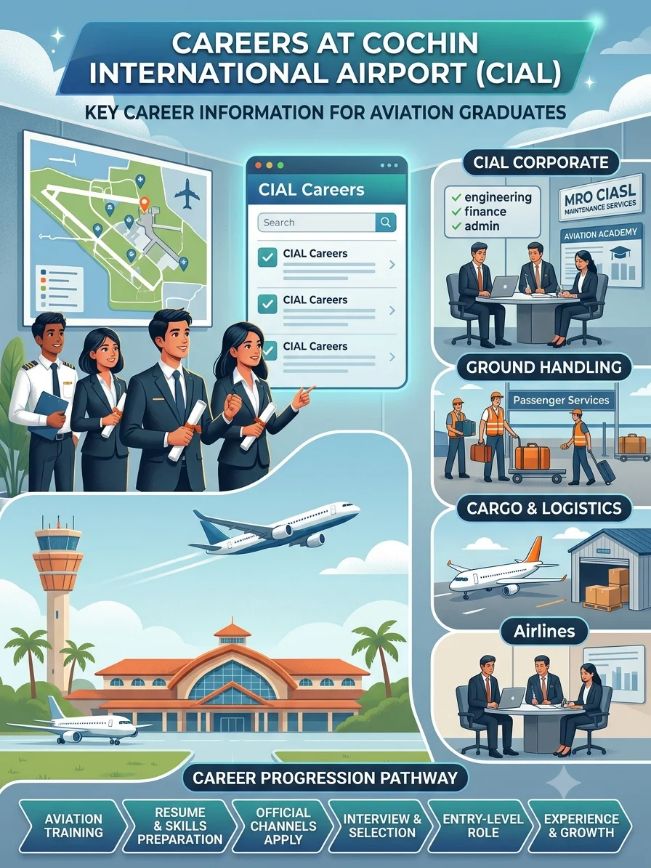
CIAL's CIAL 2.0 initiative is the most locally relevant example. The Rs 200-crore project has deployed AI surveillance, automated screening, biometric smart gates, and India's first airport-based cybersecurity centre — all at one Kerala airport. CIAL's Managing Director has publicly described the airport's long-term vision as a regional innovation and logistics hub integrating technology, clean energy, and tourism over the next two decades. That is a long runway of operational growth, and it requires trained people at every level.
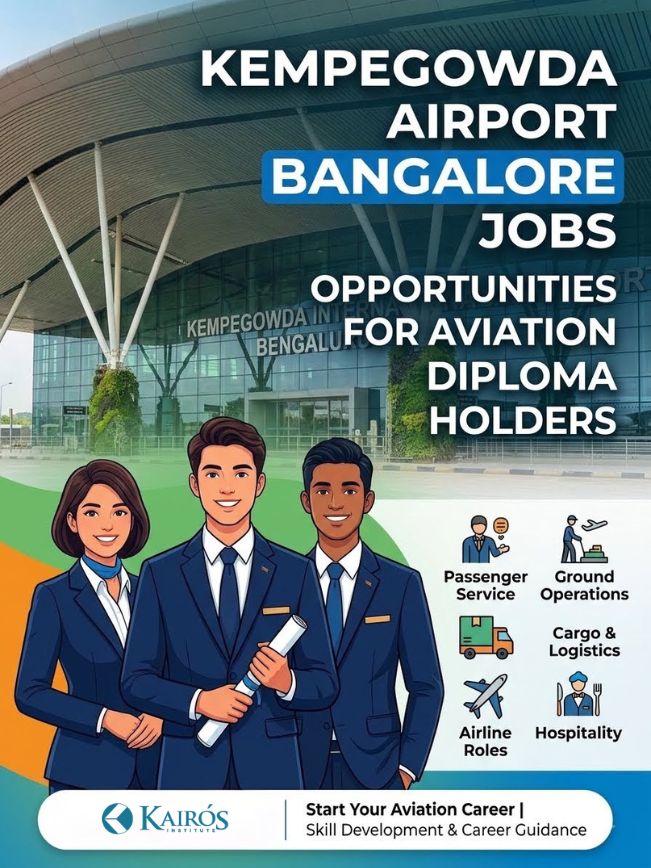
Bengaluru's Kempegowda International Airport is mid-expansion with multiple smart infrastructure projects running in parallel, increasing demand for trained aviation professionals in Karnataka.
Thiruvananthapuram International Airport is also undergoing modernisation, adding to the regional pipeline of opportunities for graduates from Kerala-based aviation institutes.
Beyond domestic airports, the Gulf aviation corridor matters enormously for Kerala students. Airports in Dubai, Abu Dhabi, Doha, and Riyadh are among the most technologically advanced in the world. Graduates who arrive with both solid operational training and digital literacy have a measurable advantage over candidates who have only one of the two — and Kairos alumni are already placed across these markets.
Aviation Courses at Kairos Institute
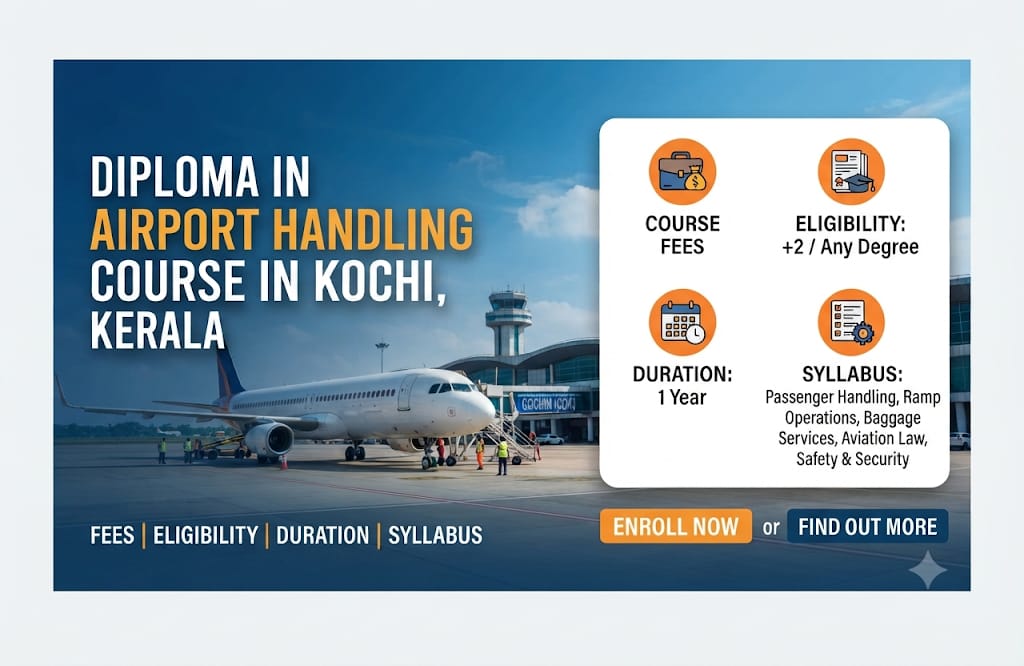
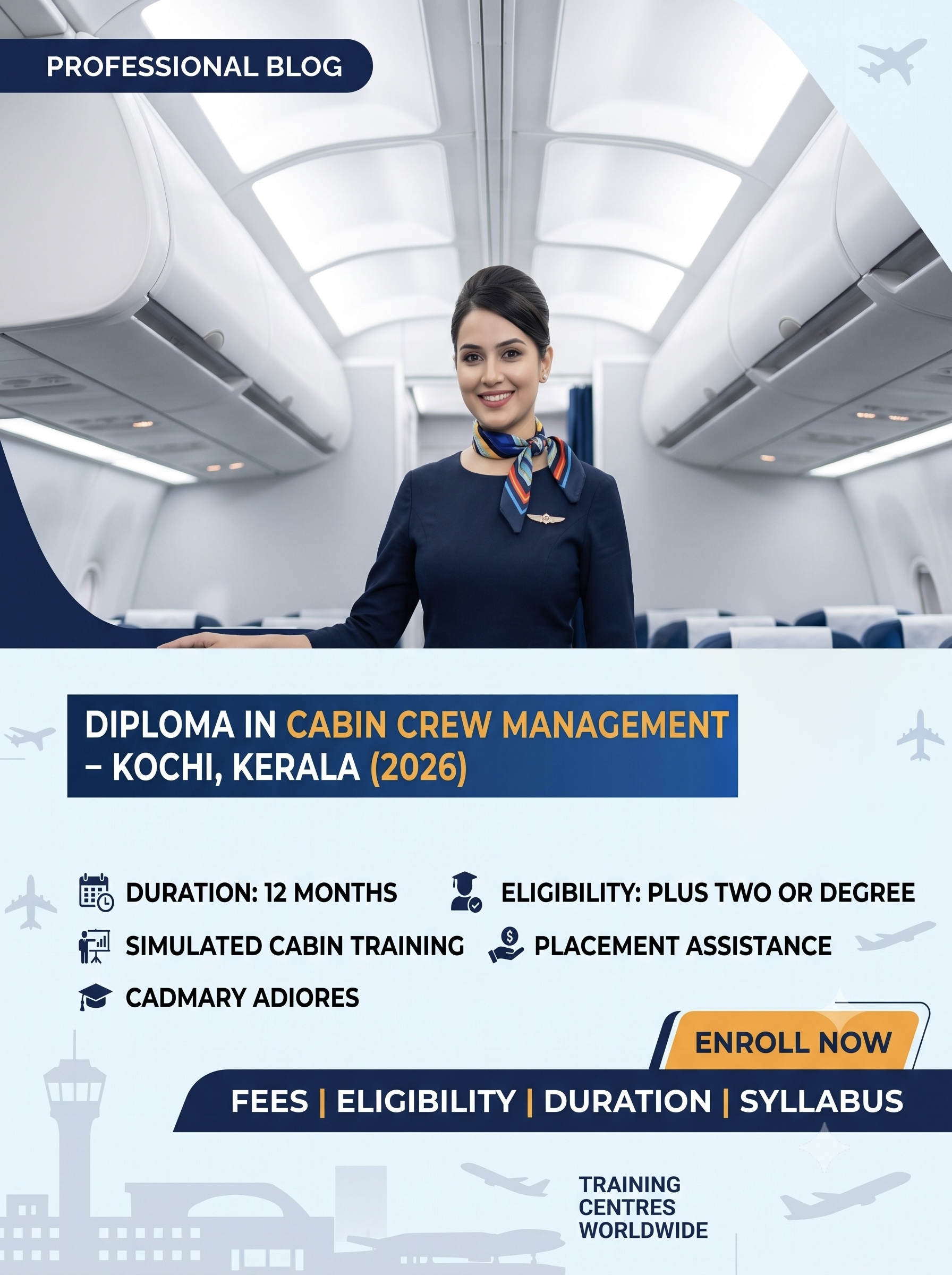
Kairos Institute offers a range of aviation programs designed to prepare students for this evolving industry — available after Plus Two or graduation:
All programs are available at our campuses in Kochi, Thodupuzha, and Bangalore.
Why Choose Kairos Institute for Your Aviation Training?
Industry-aligned curriculum updated to reflect current airport operations and technology
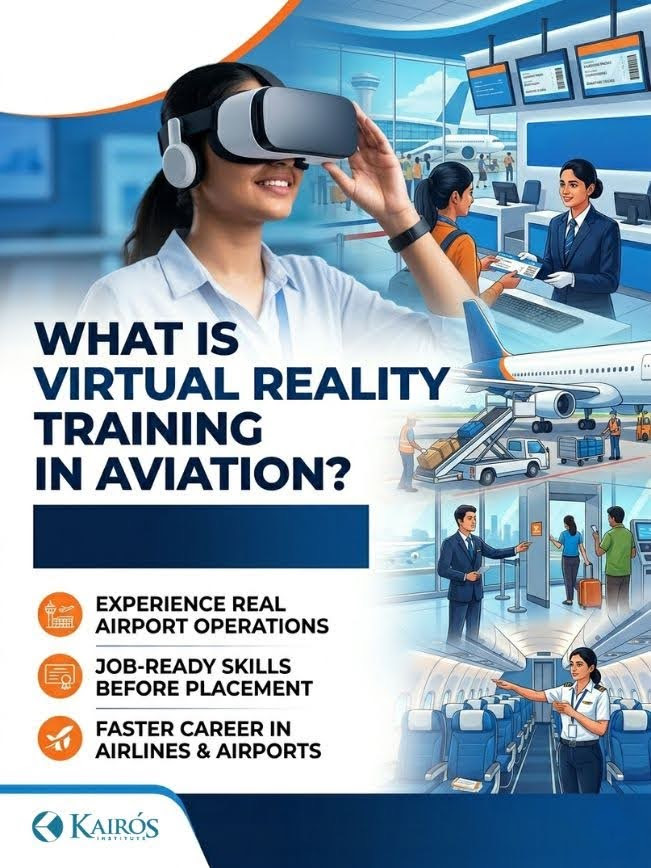
Practical, skill-based training including VR-assisted learning through our exclusive Airportverse — a 3.5 million square foot virtual airport environment
Classes conducted by active industry professionals — pilots, cabin crew, ground staff, and airline operations personnel
100% placement assistance with a network spanning domestic airports, Gulf carriers, and leading logistics and hospitality organisations
Campuses in Kochi, Thodupuzha, and Bangalore — close to real airport environments and industry activity
Final Thoughts
A career in airport management in 2026 is not a risk — it is an opportunity, provided you prepare for the version of the industry that actually exists today. Technology is not eliminating trained airport professionals. It is raising the bar on what they are expected to know and do. Students who arrive with structured training, digital awareness, and strong communication skills will find themselves ahead of the curve, not behind it.
If you want to understand which aviation course suits your background and career goals, our counsellors at Kairos Institute are available to walk you through your options clearly — with no pressure and no assumptions about where you should end up.
Reach out to us at any of our branches inKochi,Thodupuzha, orBangalore, or connect with us on WhatsApp at +91 80 780 290 50.