
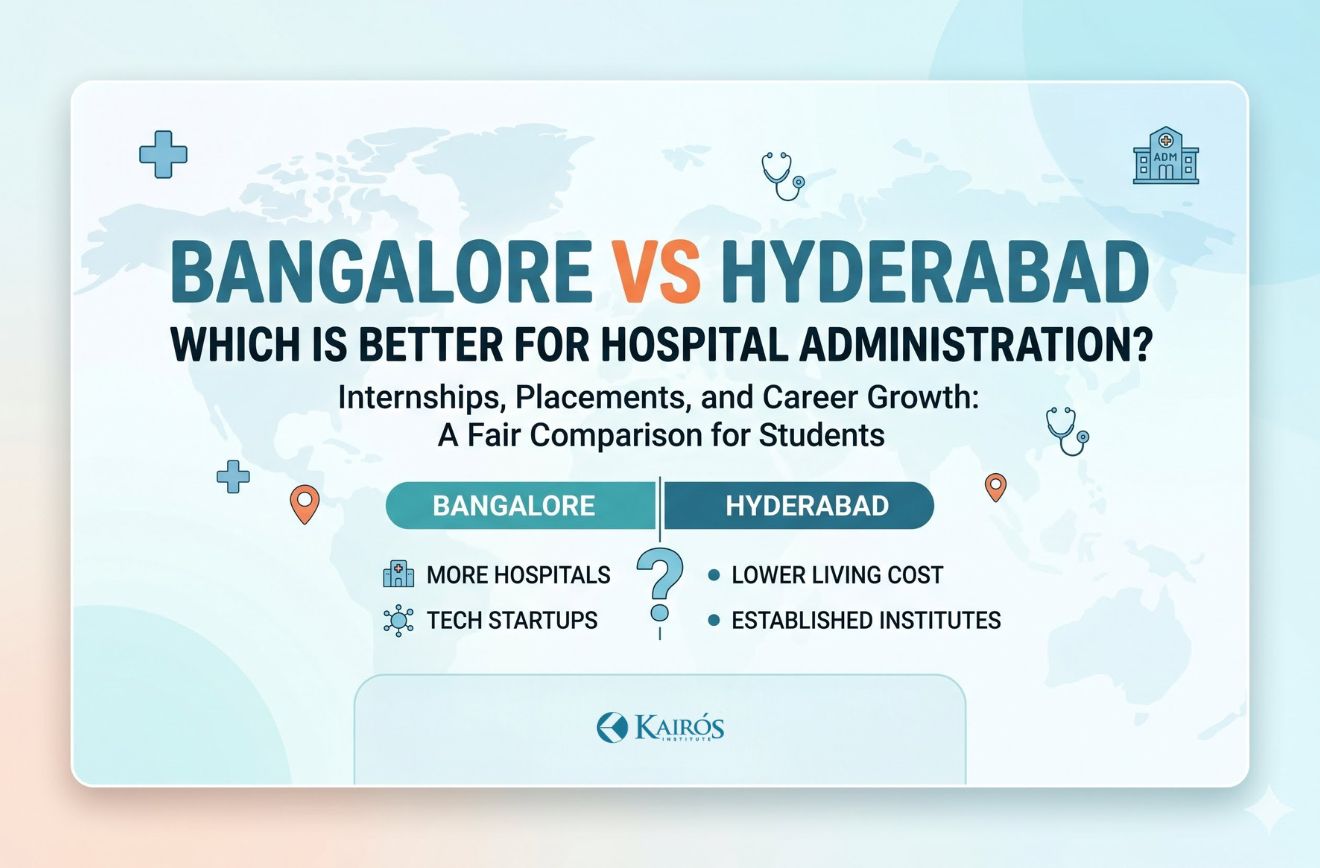
Is Bangalore a Better City Than Hyderabad to Study Hospital Administration?
Admissions Started
Book your seat Now!
- AIRPORT MANAGEMENT
- LOGISTICS & SUPPLY CHAIN MANAGEMENT
- HOSPITAL ADMINISTRATION
- DIPLOMA & PG DIPLOMA
- 6 MONTHS & 1 YEAR
If you're trying to decide between Bangalore and Hyderabad for a hospital administration course, you're not alone. It's one of the most common questions students and parents ask — especially those coming from Kerala, Tamil Nadu, and other South Indian states who are weighing both cities as study destinations.
Both cities have real hospitals, real job opportunities, and institutes that offer hospital administration programmes. So the question is not whether either city works — it's which one works better for you, based on what actually matters when you're investing time, money, and two to three years of your life.
This blog gives you a fair, honest comparison. No fluff. No vague answers.
Why Are Students Even Comparing These Two Cities?
Here's the real mindset behind this search — and it's worth naming it clearly.
Students are thinking: "I want a career in hospital management. Which city gives me better internships, better jobs after I graduate, and a better learning environment?"
Parents are thinking: "Which city is safer, more affordable, and actually gets my child placed after the course? I don't want to spend money on a degree that leads nowhere."
Both are valid. And both deserve real answers, not just a list of pros and cons that says everything and decides nothing.
Let's go through each factor that actually matters.
1. Hospital Infrastructure: Where Will You Actually Learn?
Hospital administration is not a course you can learn only from textbooks. The hospitals available to you for internships and case studies are a core part of your education.
Bangalore is home to some of India's most prestigious and large-scale medical institutions: Apollo, Manipal Hospitals, Fortis, Narayana Health, Aster CMI, and Columbia Asia, among others. Bangalore also has a growing cluster of healthcare startups and digital health companies that are changing how hospital systems operate. Students here get exposure to both traditional hospital management and the newer tech-enabled side of healthcare.
Hyderabad also has a strong hospital network. NIMS (Nizam's Institute of Medical Sciences), Apollo Hospitals (which actually runs one of India's oldest hospital administration institutes: the Apollo Institute of Hospital Administration, established in 1994), Care Hospital, Yashoda Hospital, and KIMS are all active in the city. Hyderabad's pharma industry is also massive, which creates adjacent healthcare management opportunities.
What this means for you: Both cities have quality hospital networks. But Bangalore's hospital density, combined with its healthcare startup ecosystem, gives students more variety from multi-speciality operations to digital health projects to international patient management (Bangalore receives significant medical tourism from African and Southeast Asian countries).
Edge: Bangalore, for students who want breadth of exposure and access to healthcare innovation alongside traditional hospital management.
2. Job Opportunities After the Course: Where Do Graduates Get Hired?
This is the most important factor and the one most blogs skip.
Hospital administration job opportunities in Bangalore, particularly across private hospital systems like Apollo and Manipal, often provide salaries ranging from ₹8 lakh to ₹15 lakh and above at the experienced level. Entry-level roles in Bangalore typically start at ₹3.5 to ₹5 lakh per year for fresh diploma and BBA graduates.
In Hyderabad, the average hospital manager salary is around ₹4.4 lakh per year, with top-paying employers including Care Hospital, ESIC Hospitals, and Yashoda Hospital.
Both cities offer real jobs. But Bangalore has more active hospital administration openings at any given time because the city's hospital expansion is faster and more continuous. Narayana Health and Manipal, both Bangalore-headquartered, actively hire graduates from hospital administration programmes. Metro cities like Bangalore and Hyderabad generally offer higher salary packages compared to tier-2 cities, due to larger hospital networks, higher revenues, and stronger demand for trained healthcare professionals.
The bigger picture: Graduating from a Bangalore-based institute puts you geographically closer to these employers during your internship, which is often where placements actually happen. Being on the ground matters; you show up, you build connections, and you get noticed.
Edge: Slight advantage for Bangalore, more volume of openings, and better access to large multi-specialty chains headquartered there.
3. Course Quality and Institutes: Who Teaches Better?
Hyderabad has established names in hospital administration education. NIMS has been running programmes for decades. The Apollo Institute of Hospital Administration is well-regarded. Deccan School of Management (affiliated with Osmania University) offers an MHA. The Administrative Staff College of India (ASCI) offers a PG Diploma in Hospital Management.
Bangalore also has solid institutions, St. John's National Academy of Health Sciences, MS Ramaiah Medical College, Christ University, and Mount Carmel College, all of which offer hospital administration programmes. Kairos Institute, with its Bangalore campus in Koramangala, offers industry-focused programmes specifically designed for quick, career-ready outcomes.
What separates institutes in both cities is not just the name on the certificate. It is:
Whether the curriculum is updated to reflect how hospitals actually operate in 2026
Whether internships are structured and supervised, or just something you arrange yourself
Whether the faculty includes working hospital professionals, not only academics
Whether placement is actively managed, with actual employer connections
This matters more than the city.
What to check before enrolling (in either city): Ask the institute for the names of 5 hospitals where their recent students interned. Ask about their placement record, specifically the batch of 2024 or 2025. If they can't answer clearly, that tells you something.
4. Cost of Living: Where Does Your Budget Go Further?
This is where Hyderabad clearly wins, and it's worth being honest about it.
Hyderabad is 20 to 35 percent cheaper than Bangalore overall. The biggest savings come from rent (30 to 40 percent lower) and dining out (20 to 25 percent cheaper).
The average monthly living cost in Hyderabad for students ranges from ₹10,000 to ₹20,000 per month. In Bangalore, students typically need ₹18,000 to ₹25,000 per month for a basic but comfortable lifestyle, and that's before accounting for Bangalore landlords' well-known practice of demanding large advance deposits.
Hyderabad is 18 percent cheaper than Bangalore per month, overall saving approximately ₹4,180 every month, or ₹50,160 annually on a budget lifestyle.
In practical terms, if your parents are budgeting ₹15,000 per month for your living expenses and the course fees are similar, Hyderabad is easier on the family. Bangalore is more expensive to live in, though students who manage shared accommodation in areas like Koramangala or Banashankari can make it work at around ₹18,000 to ₹20,000 per month.
Edge: Hyderabad, clearly more affordable for student living.
5. Internship Access: Where Do You Get Real Hospital Exposure?
An internship in a hospital administration course is not optional. It's the part that actually teaches you how a hospital runs patient flow, billing systems, staff scheduling, NABH compliance, vendor management, and operations under real pressure.
In Bangalore, students studying at institutes with strong hospital tie-ups can intern at Apollo Bannerghatta Road, Narayana Health City, Fortis Hospital Cunningham Road, Manipal Hospital Old Airport Road, and others. These are large, multi-speciality, high-volume environments. The learning curve is steep, but that's the point.
In Hyderabad, Apollo AIHA places its own students directly in Apollo network hospitals. NIMS students get exposure within the NIMS campus, which is a 1,000-plus-bed teaching hospital. Yashoda and Care Hospitals also participate in internship programmes for management students.
What matters more than the city: Does your specific institute have a signed agreement with named hospitals, or are you expected to find your own internship? The difference is enormous. An unstructured "go find a hospital" internship teaches you very little.
6. Life as a Student: Safety, Culture, and Comfort
Both Bangalore and Hyderabad are large, cosmopolitan cities with active student communities. Students from Kerala, Tamil Nadu, Andhra Pradesh, and Telangana are well-represented in both.
Bangalore: More diverse, more expensive, pleasant climate year-round. Public transport has improved significantly with the Namma Metro expansion. Traffic is the city's biggest complaint — plan your accommodation close to your institute to avoid spending hours commuting.
Hyderabad: Slightly more relaxed pace, better roads inside the city, strong Biryani game (genuinely important to student life). Summers can be hot. Cheaper accommodation options are more readily available. The city has a strong Telugu-speaking community, which can take some getting used to for students coming from other states, though English and Hindi are widely used in professional settings.
For students coming from Kerala, especially, both cities feel equally unfamiliar at first. The difference settles once you make a few friends and find your rhythm.
7. International Career Opportunities: Which City Gives You a Better Launch Pad?
If your goal is to eventually work in the Gulf, UK, Canada, or Australia after completing your hospital administration course, this factor deserves attention.
Bangalore's hospital networks have more experience with international patients, international accreditation (JCI-accredited hospitals like Manipal), and international healthcare partnerships. Having a certificate from a Bangalore-based institute and internship experience from a JCI or NABH hospital carries real recognition when applying for international roles.
A fresh graduate with a government-recognised diploma can expect ₹3.5 to 6 lakh per year at the entry level, with 5 years of experience taking salaries to ₹8 to 15 lakh per year. Senior professionals with 10 or more years in the field earn ₹20 to 40 lakh per year. The international ceiling is even higher — healthcare administrators in the UAE, UK, and Canada can earn significantly more with the right credentials and experience.
Both cities can work as a launching pad. But Bangalore's exposure to international healthcare systems gives students a slight edge when preparing for global careers.
The Honest Summary: Side-by-Side Comparison
Factor | Bangalore | Hyderabad |
Hospital network size | Larger, more diverse | Strong, established |
Job availability | More openings | Good, but fewer |
Salary after the course | Slightly higher | Competitive |
Cost of living | Higher | 18–20% cheaper |
International exposure | Stronger | Moderate |
Healthcare startup access | Much stronger | Limited |
Student life | Cosmopolitan, busy | Relaxed, affordable |
Internship quality | Depends on the institute | Depends on the institute |
So, Is Bangalore Better?
For most students, yes, Bangalore is the better city to study hospital administration, for these specific reasons:
The volume and variety of hospitals available for internships are higher
Job placement opportunities post-course are more plentiful
The healthcare innovation ecosystem (digital health, health-tech startups) gives you exposure that Hyderabad doesn't yet match
International career pathways are more actively supported
But Hyderabad is the right choice if: your budget is genuinely tighter and you want to minimise living costs, or if you're specifically targeting roles within Hyderabad's pharmaceutical or government healthcare sector after graduation.
The city matters. But the institute matters more.
A student who joins a well-structured, placement-focused programme in Bangalore with real hospital internships and government-recognised certification will almost always do better than a student who joins a poorly structured programme in any city.
What Kairos Institute Offers in Bangalore
Kairos Institute's Bangalore campus is located in Koramangala, one of the city's most connected and student-friendly areas. Two hospital administration programmes are available:
The BBA in Hospital Administration is a three-year undergraduate programme that covers healthcare management, hospital operations, medical ethics, finance, and human resource management. Graduates are ready for leadership roles in hospitals, clinics, and healthcare organisations across India and abroad.
The International Diploma in Hospital Administration is available in 6-month and 1-year options. It is internationally accredited, government-recognised, and built around practical hospital management with a strong placement support framework. This is the right choice for students who want to start working within a year, including those targeting Gulf country opportunities.
Both programmes come with 100% placement support and access to hospital internships through Kairos's industry partnerships.
Related Reads
If you are still researching your options, these two resources will help:
Hospital Administration Course Fees in Bangalore: What to Expect in 2026–27: a detailed breakdown of what different course levels actually cost, what's included, and how to evaluate whether a programme is worth the investment.
Hospital Administration Course in Bangalore: Full Overview: covers why Bangalore specifically is a strong city for hospital administration education, which hospitals are active in the city, and what career paths open up after the course.
Top Hospital Administration Course in Kerala after 12th — Fees, Colleges, Syllabus: for students from Kerala comparing South India options before deciding on a city.
One Last Thing for Parents
If your child has already expressed interest in hospital administration and you're the one doing the research, that interest is worth taking seriously. Hospital administration is one of the few healthcare career paths that doesn't require NEET, doesn't require a medical background, and still leads to respected, stable, well-paying roles in the healthcare sector.
The question is not whether to pursue it. The question is where to do it well. And that answer starts with finding the right institute, in whichever city you choose.
Popular Blogs

Diploma in Airport Handling Course in Kochi, Kerala: Fees, Eligibility, Duration & Syllabus
Read More
Diploma in Warehouse Management Course in Kochi, Kerala: Fees, Eligibility, Duration & Syllabus
Read More

Diploma in Cabin Crew Management Course in Kochi, Kerala: Fees, Eligibility, Duration & Syllabus (2026)
Read More








What Certifications Should Your Aviation Institute Have? A Complete Guide for Students and Parents in Kerala
Read More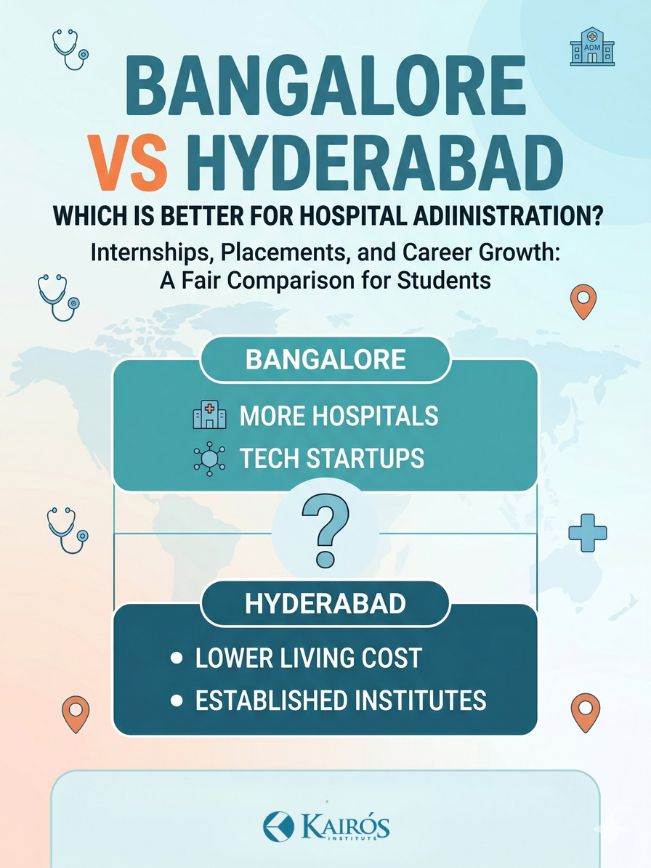



How AI and Automation Are Changing Airport Jobs in 2026 — and What It Means for Your Career
Read More
What Is Virtual Reality Training in Aviation? How Kairos Institute Uses VR for Student Learning
Read More
How to Choose the Best Aviation Institute in Kerala — 7 Things to Check Before You Enrol (2026)
Read More