
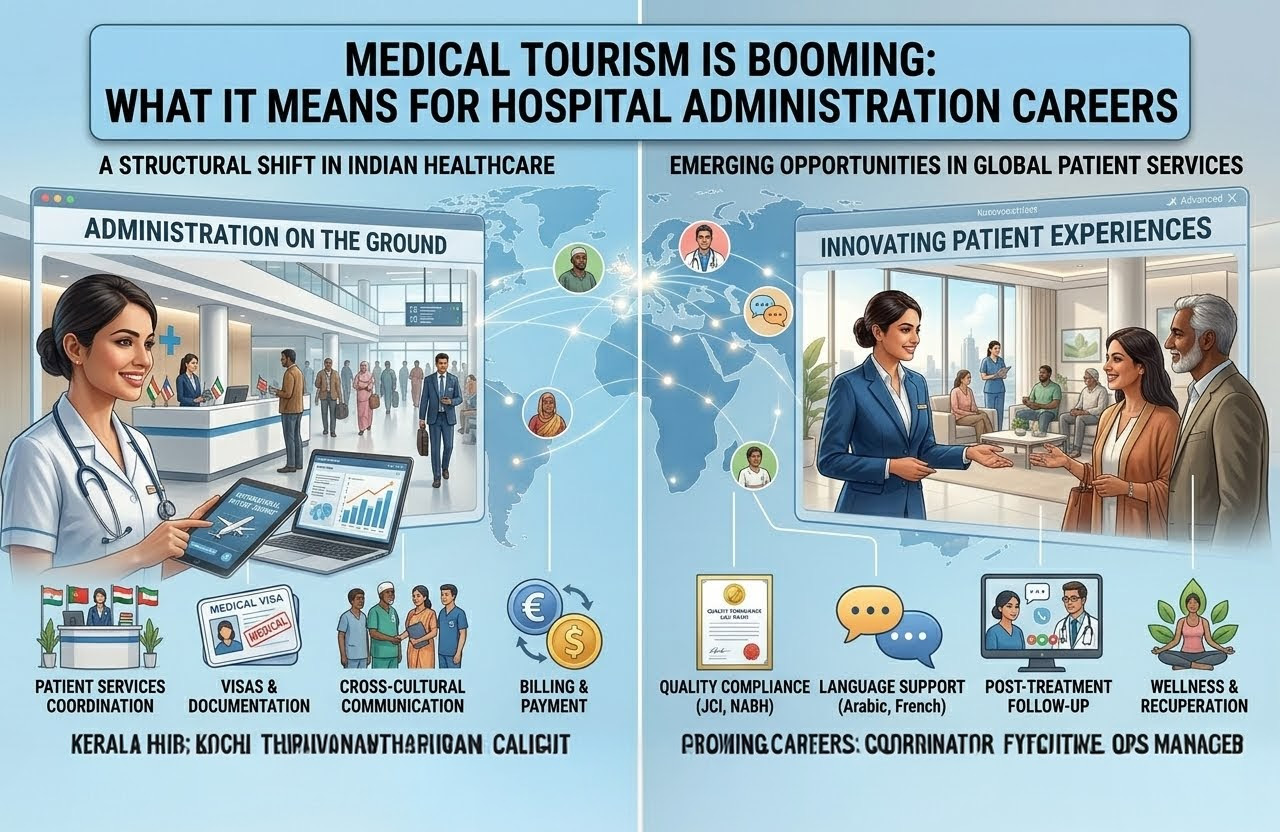
Medical Tourism Is Booming: What It Means for Hospital Administration Careers
Admissions Started
Book your seat Now!
- AIRPORT MANAGEMENT
- LOGISTICS & SUPPLY CHAIN MANAGEMENT
- HOSPITAL ADMINISTRATION
- DIPLOMA & PG DIPLOMA
- 6 MONTHS & 1 YEAR
Something significant is happening in Indian healthcare, and most students considering a hospital administration career have not fully connected the dots yet.
India's medical tourism market was valued at approximately USD 11 billion in 2025 and is projected to reach USD 22 billion by 2031. Foreign patient arrivals jumped from under 200,000 in 2020 to over 644,000 in 2024 — more than tripling in four years. The Government of India has now extended its e-Medical Visa facility to nationals of 171 countries, removing one of the last remaining barriers to international patients choosing India for treatment.
This is not a niche trend. It is a structural shift in how Indian hospitals operate — and it is creating demand for a new category of hospital administration professional that barely existed a decade ago.
If you are considering a career in hospital administration, understanding this shift is not optional. It is the most important context for where the industry is heading and where the best opportunities will come from.
What Is Medical Tourism and Why Is India at the Centre of It?
Medical tourism refers to the practice of travelling to another country specifically to receive medical treatment. Patients do this for three primary reasons: cost, quality, or access to procedures not available in their home country.
India offers all three simultaneously, which is rare among global competitors.
A cardiac bypass surgery that costs USD 100,000 in the United States can be performed at an accredited Indian hospital for as little as USD 5,000 — with comparable clinical outcomes. Orthopedic procedures, cancer treatments, organ transplants, and fertility treatments follow a similar cost structure. India also has over 170 da Vinci robotic surgery systems in operation, with more than 850 trained surgeons — a level of technology that many patients in developing countries cannot access domestically.
The countries sending the most patients to India reflect this. Bangladesh, Iraq, Maldives, Afghanistan, Oman, Yemen, and several African nations account for the majority of medical tourist arrivals — patients from countries where either the technology is unavailable or the cost at home is prohibitive. These patients are not looking for cheap care. They are looking for world-class care at a price that is actually within reach.
India is now ranked 10th out of 46 countries in the global Medical Tourism Index — placed within an established, competitive field of destinations that includes Thailand, Malaysia, and Singapore. Holding that position requires more than good surgeons. It requires hospital operations, patient services, and administrative infrastructure that can handle international patient volume professionally.
What This Means for Kerala Specifically
Kerala sits at the centre of India's medical tourism story in a way that makes this particularly relevant for students in the state.
Kerala receives over five lakh foreign patients seeking treatment annually, with the sector seeing annual growth of 25 to 30 percent. Approximately 25 to 30 percent of the revenue of major hospitals in the state now comes from health tourism. That is not a fringe activity — it is a core revenue stream.
Hospitals in Kochi are among the most active in this space. Aster Medcity in Kochi has a dedicated Guest Relation Team handling all aspects of the international patient journey — from pre-arrival planning through discharge. Amrita Hospital Kochi runs a full international patients department with consultation, diagnostics, and surgical treatment coordination for patients arriving from the Middle East, Africa, and South Asia. Medical Trust Hospital has structured health tourism packages specifically designed for international patients that combine clinical treatment with follow-up care and wellness experiences.
These are not peripheral services added as an afterthought. They are staffed departments with dedicated professionals whose entire role is managing the administrative, logistical, and experiential side of treating patients who have travelled across borders for care.
Kerala's well-connected airports in Kochi, Thiruvananthapuram, and Calicut make travel easy for international patients, and the state is known for warm hospitality, with hospitals and wellness centres providing personalised care tailored to patients' needs. This combination — clinical excellence, connectivity, and service culture — is exactly why Kerala hospitals have built dedicated international patient infrastructure, and why trained administrators are needed to run it.
How Medical Tourism Changes What Hospital Administrators Do
A traditional hospital administration role focuses on domestic operations: managing OPD flow, coordinating departments, overseeing billing, maintaining compliance, and handling patient feedback. These responsibilities remain the foundation.
Medical tourism layers an entirely different set of demands on top of that foundation.
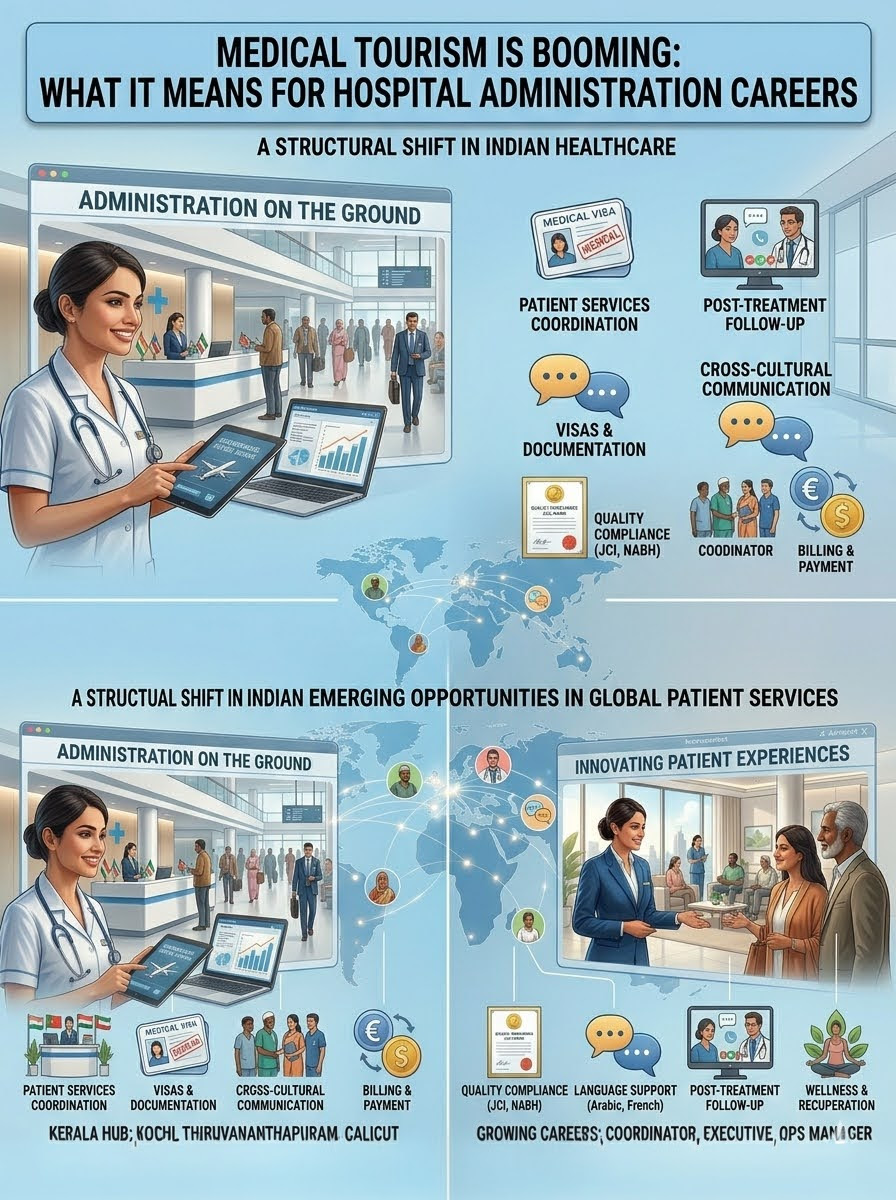
International Patient Services and Coordination
Hospitals handling international patients need professionals specifically managing the pre-arrival process. This includes reviewing patient medical records sent from abroad, coordinating with clinical teams to prepare cost estimates and treatment plans, communicating with patients and families across time zones, and arranging visa support documentation. At a hospital like Aster Medcity or Medical Trust in Kochi, this work happens daily — and it requires a combination of operational knowledge, communication skill, and genuine patient-facing warmth that generic administrative training does not automatically produce.
Cross-Cultural Communication and Language Support
International patients arrive from Arabic-speaking Middle Eastern countries, French-speaking African nations, and South Asian countries where English may be a second or third language. Administrators managing these patients must handle communication carefully — ensuring that treatment plans, consent processes, billing breakdowns, and discharge instructions are understood clearly by patients who are already in a vulnerable position far from home.
This is a genuine skill that hospitals actively look for when hiring. It is not something learned only on the job. Students who have been specifically trained in patient-facing communication, cultural sensitivity, and professional service delivery step into these roles with a measurable advantage.
Billing, Insurance, and International Payment Coordination
Domestic hospital billing is already complex. International patients introduce an additional layer: foreign insurance claims, international wire transfers, currency exchange documentation, and in some cases, embassy or government-sponsored treatment schemes. Administrators in medical tourism departments handle all of this — often serving as the bridge between the hospital's finance team and the patient's insurer or sponsor abroad.
Quality Compliance and Accreditation Management
Hospitals that attract international patients must meet international accreditation standards. JCI (Joint Commission International) and NABH (National Accreditation Board for Hospitals) accreditation are the two primary benchmarks. Maintaining these certifications requires ongoing documentation, audit readiness, and process compliance work — all of which falls within the hospital administration function. Administrators who understand what these standards require and how to support compliance processes are increasingly valuable in hospitals competing for international patient volume.
Post-Treatment and Follow-Up Coordination
A medical tourist's care does not end at discharge. Many patients require follow-up consultations, reports sent to their home physician, or ongoing case monitoring after they return to their country. Managing this post-treatment pipeline — coordinating between the hospital's clinical team and a patient who is now in another country — requires organised administration and genuine attention to detail. Hospitals that do this well build reputations that drive referrals. Those that do it poorly lose repeat business and word-of-mouth trust in source markets.
The Roles Being Created by This Boom
Medical tourism growth is not just expanding existing hospital administration roles — it is creating new ones that did not exist in meaningful numbers five years ago.
Roles now hiring actively in Kerala and other major medical tourism hubs:
International Patient Coordinator — manages the full journey of foreign patients from inquiry through discharge and follow-up
Medical Tourism Facilitator — works with travel and health tourism agencies to coordinate patient arrivals, accommodation, and logistics
Quality and Accreditation Executive — supports JCI and NABH compliance documentation and audit preparation
Patient Relations Officer (International Desk) — handles communication, feedback, and service recovery for international patients
Health Tourism Marketing Executive — manages outreach to source markets, partnerships with international agencies, and digital presence for international patient acquisition
Medical Billing and Insurance Coordinator — handles international claims, corporate health tie-ups, and foreign payment processing
Operations Manager — International Services — oversees the complete international patient services division within a hospital
These roles exist across Apollo Hospitals, Fortis Healthcare, Max Healthcare, Narayana Health, Manipal Hospitals, Aster, and Amrita — the hospital networks that dominate India's medical tourism landscape. They also exist in Kerala-specific hospitals that have built dedicated international patient departments to serve Gulf and African market demand.
What Skills This Career Path Requires
Medical tourism-facing hospital administration work requires the same foundational skills as any hospital administration role — operations coordination, documentation, compliance understanding, and systems familiarity. But three additional skills consistently separate strong candidates in this space.
Cross-cultural communication is the first. Working confidently with patients from different countries, communicating complex medical and financial information clearly, and maintaining professionalism and empathy across cultural contexts is a daily requirement in international patient services — not an occasional one.
Service orientation under pressure is the second. International patients are often anxious, sometimes travelling without family, and navigating a healthcare system that operates in a language or cultural frame different from their own. Administrators who can remain calm, organised, and genuinely helpful in these conditions are valued significantly above those who can only manage paperwork efficiently.
Operational breadth is the third. Medical tourism administration touches clinical coordination, finance, compliance, communications, and logistics — often in the same working day. Professionals who understand how these departments connect, rather than only knowing their own lane, grow faster and take on more responsibility earlier in their careers.
Why This Is the Right Time to Enter This Field
The structural conditions driving medical tourism growth in India are not temporary. Cost advantage over OECD-rate healthcare is structural. Growing middle-income populations in Africa and Central Asia choosing accredited Indian centres over pricier alternatives is a long-term trend. The Government of India's active investment in positioning the country as a global healthcare destination — through the Heal in India initiative, upgraded Medical Value Travel portals, and e-Medical Visa expansion to 171 countries — signals sustained policy commitment.
Kerala, specifically, benefits from a combination of factors that will keep it near the centre of this growth: internationally accredited hospitals, strong existing Gulf connections, multilingual healthcare professionals, and a service culture that international patients consistently rate highly.
For students entering hospital administration training now, the cohort that graduates in the next one to two years enters a job market where this demand is at an early-growth stage — not a peak, and not a plateau.
Hospital Administration Courses at Kairos Institute
Kairos Institute prepares students for hospital administration careers that are relevant to where the industry is actually heading, including the medical
All programs are available at our campuses in Kochi, Thodupuzha, and Bangalore — with Kochi placing students directly in one of India's most active medical tourism markets.
Why Choose Kairos Institute for Your Hospital Administration Training?
Curriculum designed around the operational realities of modern Indian hospitals — including international patient services, quality compliance, and cross-cultural communication
Training delivered by healthcare and management professionals with real hospital operations experience
Strong placement network across hospitals in Kerala, Karnataka, and beyond — including institutions actively growing their international patient services divisions
Communication, service delivery, and professional presentation built into every program
Campuses in Kochi, Thodupuzha, and Bangalore — close to the healthcare environments where these roles are being hired
Final Thoughts
Medical tourism is not a trend that hospital administrators can observe from a distance. It is already reshaping what hospitals in Kerala and across India need from their administrative teams — and it is creating roles, skills requirements, and career paths that did not exist at this scale a few years ago.
Students who understand this context before they begin training are already thinking about their career differently from those who do not. The hospitals growing fastest in this space are the ones investing in people who can manage international patients professionally — and that investment is happening right now, in the very cities where Kairos has its campuses.
If you want to understand which hospital administration program fits your background and goals, our counsellors are available to walk you through your options clearly and honestly.
Reach out to us at any of our branches inKochi,Thodupuzha, orBangalore, or connect with us on WhatsApp at +91 80 780 290 50.
Popular Blogs


What Certifications Should Your Aviation Institute Have? A Complete Guide for Students and Parents in Kerala
Read More


How AI and Automation Are Changing Airport Jobs in 2026 — and What It Means for Your Career
Read More
What Is Virtual Reality Training in Aviation? How Kairos Institute Uses VR for Student Learning
Read More
How to Choose the Best Aviation Institute in Kerala — 7 Things to Check Before You Enrol (2026)
Read More