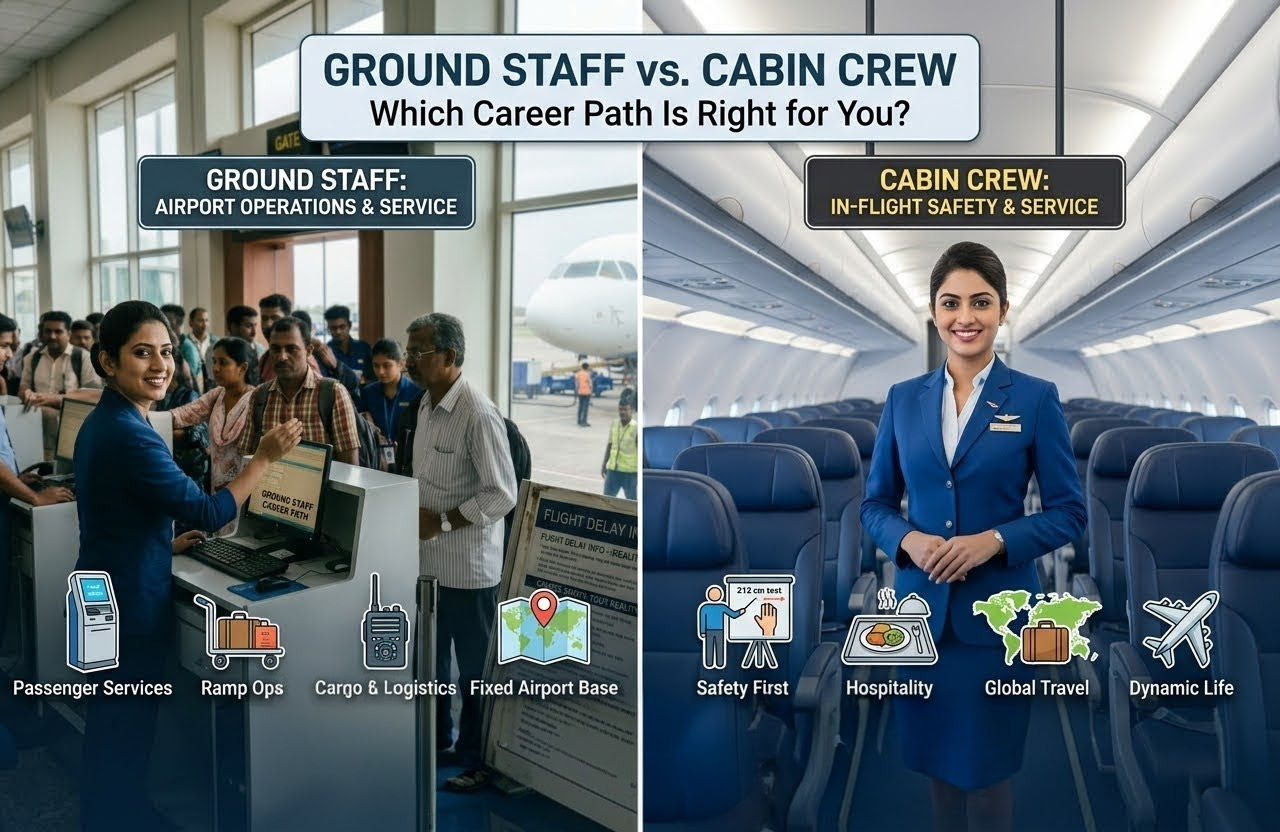
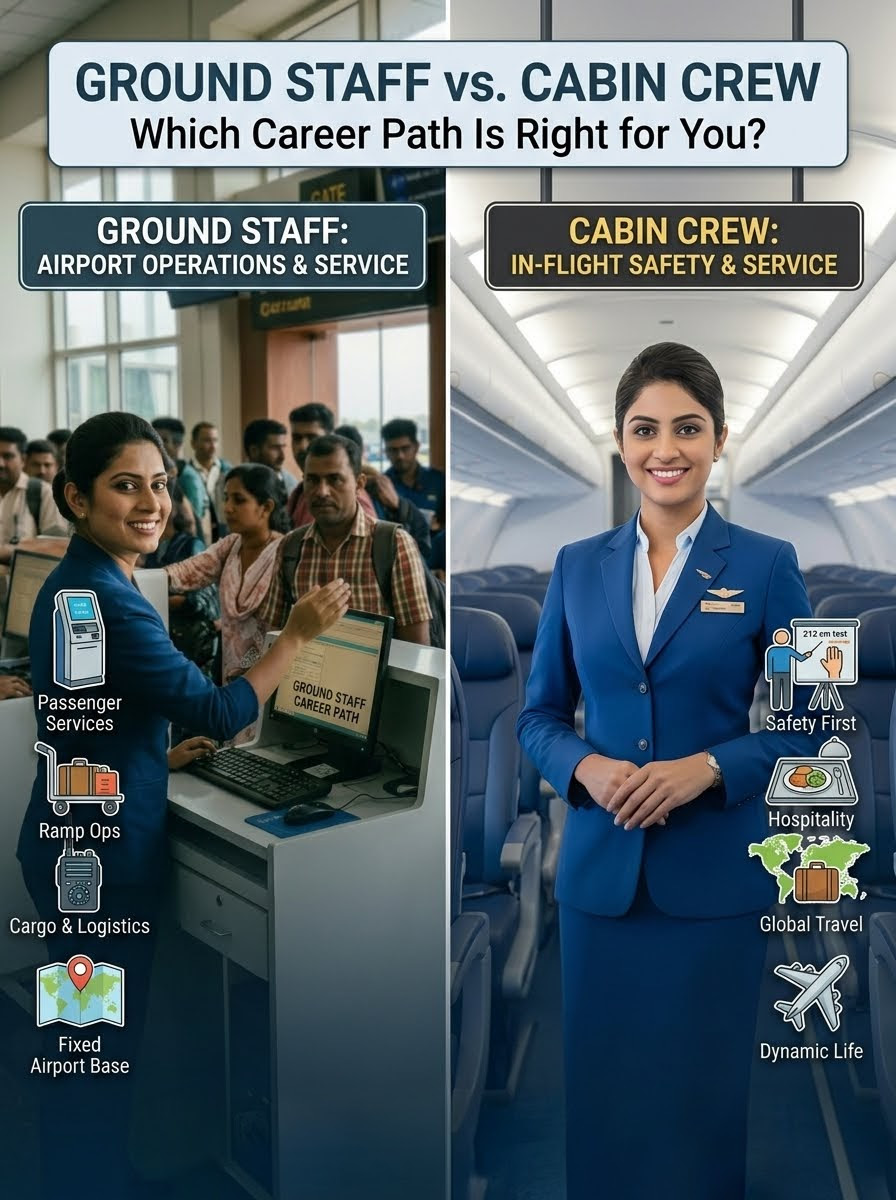
Ground Staff vs Cabin Crew: Which Career Path Is Right for You?
Admissions Started
Book your seat Now!
- AIRPORT MANAGEMENT
- LOGISTICS & SUPPLY CHAIN MANAGEMENT
- HOSPITAL ADMINISTRATION
- DIPLOMA & PG DIPLOMA
- 6 MONTHS & 1 YEAR
Every year, thousands of students in Kerala and across India walk into aviation counselling sessions with the same question: should I become ground staff or cabin crew? Both roles are part of the same industry. Both start after Plus Two. Both carry the appeal of airports, uniforms, and a career that feels different from a desk job.
But they are fundamentally different paths — in what you do every day, how you are assessed for the job, how much you earn, how your career grows, and what kind of personality actually thrives in each role.
This guide breaks down every important difference so that you can make the right choice — not based on what looks better in a photo, but based on what actually fits your goals, your lifestyle, and the life you want to build.
What Does Ground Staff Actually Do?
Ground staff are the professionals who run airport operations on the ground — before the aircraft pushes back and after it lands. They are the first and last point of contact for most passengers at the airport.
Ground staff work across different departments depending on their specialisation. A passenger services agent manages check-in, boarding, and departure coordination. A ramp agent supervises baggage loading, aircraft turnaround, and ground equipment. A cargo executive handles freight documentation, screening, and dispatch. An operations supervisor coordinates across all ground departments to ensure flights depart on time.
The work is shift-based, fast-paced, and heavily systems-driven. In 2026, ground staff increasingly work with biometric platforms, AI dashboards, and real-time flight management tools — making digital literacy as important as communication skills.
Ground staff typically stay based at one airport or city. They have fixed shift schedules, work with the same team over time, and build deep knowledge of how their specific airport runs. For students who want a stable base, structured growth, and a clear operational career path, this is a strong fit.
What Does Cabin Crew Actually Do?
Cabin crew — also called flight attendants or air hostesses — work onboard the aircraft. Their primary responsibility is passenger safety during the flight. Service, comfort, and hospitality come after safety, not instead of it.
Before every flight, cabin crew complete pre-flight safety checks on emergency equipment, review briefings with the flight deck, and prepare the cabin. During the flight, they demonstrate safety procedures, manage passenger queries and medical situations, serve food and beverages, and handle any in-flight incidents. After landing, they assist with deplaning and file reports on anything that occurred during the flight.
The lifestyle is genuinely different from any ground-based role. Cabin crew rotate through different routes, different cities, and in international airlines, different countries — often within the same week. There is no fixed office, no fixed daily schedule, and no two days that look exactly the same. For students who are drawn to travel, variety, and a role that is always moving, this is part of the appeal.
However, this lifestyle comes with real trade-offs: irregular sleep cycles, time away from home, strict physical and grooming standards maintained throughout the career, and age-window constraints that do not exist in most ground roles.
Eligibility: Where the Two Paths Differ Most
This is where many students discover that the choice is not entirely theirs to make — at least not immediately.
Ground Staff Eligibility
Education: Plus Two (any stream) from a recognised board
Age: No strict upper age limit for most ground roles; typically 18 years and above
Height: No fixed height requirement for most positions
Weight: No specific BMI criteria
Vision: Corrected vision is generally acceptable
English: Good communication skills required; bilingual is an advantage
Medical: Basic fitness; no DGCA medical certification required
Cabin Crew Eligibility
Education: Plus Two minimum; a bachelor's degree is preferred by international airlines such as Emirates, Qatar Airways, and Singapore Airlines
Age: 18 to 27 years for fresh applicants at most domestic airlines; up to 30 years for experienced candidates at select carriers
Height: Minimum 155 cm for female candidates; 170 cm for male candidates — this is a hard requirement across all Indian airlines
Weight: Proportional to height as assessed by BMI (standard healthy BMI range of 18–25 is the norm)
Arm Reach: Must reach overhead safety equipment without assistance — IndiGo and others test a standing arm reach of approximately 212 cm
Vision: 6/6 with or without correction; colour blindness disqualifies candidates
English: Fluency in English and Hindi is mandatory; additional language proficiency is a significant advantage
Medical: Must pass a DGCA Class II medical examination; no chronic illness, no visible tattoos in uniform
The single most important practical difference here is that cabin crew has physical eligibility criteria that ground staff does not. If you do not meet the height requirement, cabin crew is not an option at this point in time — and that is not something training can change. Ground staff, by contrast, is accessible to any student who meets the educational and communication baseline.
Daily Life: What You Are Actually Signing Up For
Understanding what a working week looks like in each role matters far more than what the job title sounds like.
A Ground Staff Week
Ground staff work in rotating shifts — morning, afternoon, and night — because airports never close. A typical shift runs eight to nine hours. Most ground staff are based at one airport and commute to work like any other professional. They build relationships with the same colleagues, work within clear departmental structures, and have predictable days off that can be planned in advance.
The work environment is high-pressure during peak hours — departures, delayed flights, and disrupted passengers — but calms down significantly during off-peak periods. It requires operational precision, patience, and the ability to solve problems quickly with the resources available.
Click Here to know More about Daily Life of a Ground Staff
A Cabin Crew Week
Cabin crew do not have a standard working week in the traditional sense. Duty assignments are rostered in advance but can change. A domestic cabin crew member might operate three or four sectors in a single day and be home the same night. An international crew member might be away from home base for two to three days on a layover, then return for a rest period.
The work itself is intense during flights — especially on longer sectors — and requires sustained energy, professional composure, and physical alertness regardless of the time of day or how many sectors have already been flown. Rest periods between duties are protected by DGCA regulations, but irregular sleep patterns are a consistent reality of the job.
Salary: Honest Numbers for 2026
Both careers offer competitive starting salaries. The difference grows with experience, the airline, and whether you are flying domestic or international routes.
Ground Staff Salary in India (2026)
Entry level (domestic airports): ₹18,000 to ₹40,000 per month
With experience (metro airports): ₹40,000 to ₹80,000 per month
Senior operations / supervisory roles: ₹60,000 to ₹1,00,000+ per month
Gulf airport placements: Salary packages typically higher, with additional housing and transport allowances
Cabin Crew Salary in India (2026)
Domestic airlines — freshers: ₹28,000 to ₹50,000 per month including flying allowances
Air India (new joiners): ₹53,000 to ₹61,000 per month
International airlines (Emirates, Qatar Airways): ₹80,000 to ₹1,50,000+ per month — tax-free, with accommodation and transport allowances in most Gulf postings
Senior / long-haul international cabin crew: ₹1,00,000 to ₹2,00,000+ per month
Two things are worth noting here. First, cabin crew at international airlines earn significantly more — but reaching those positions requires clearing physical eligibility, completing training, gaining domestic experience, and then reapplying internationally. The path takes time. Second, ground staff salary grows more steadily and has no age ceiling — a ground professional who builds operational expertise and moves into supervisory or management roles can match or exceed mid-level cabin crew salaries without the physical constraints.
Career Growth: Where Can Each Path Take You?
Neither career is a dead end. Both have clear growth trajectories — but they point in different directions.
Ground Staff Career Progression
Check-in Agent → Senior Passenger Services Agent
Ramp Agent → Ramp Supervisor → Ground Operations Manager
Cargo Executive → Cargo Manager → Import/Export Head
Airport Operations Executive → Station Manager → Airport Director
Transition into airline management, logistics, or aviation administration at senior levels
Ground staff roles feed directly into management careers within the aviation and logistics sector. Many senior airport managers, airline operations heads, and even aviation consultants began as ground staff. The technical knowledge built in ground operations is transferable across airports, airlines, and countries.
Cabin Crew Career Progression
Trainee Cabin Crew → Junior Cabin Crew
Cabin Crew → Senior Cabin Crew
Senior Cabin Crew → Purser / In-Flight Supervisor
Purser → Cabin Crew Trainer or In-Flight Manager
Transition into airline hospitality management, crew training, or customer experience leadership
Cabin crew growth is largely within the airline structure. The most experienced cabin crew become trainers, check cabin crew, or move into airline hospitality operations. Career longevity depends heavily on the airline — larger carriers offer more senior roles, while smaller ones may have limited progression beyond senior crew.
Which Personality Fits Which Role?
This is a question that no eligibility chart can answer for you, but it is often the most useful question to ask.
You are likely better suited for a Ground Staff career if:
You prefer having a fixed base and want to come home at the end of most shifts
You enjoy operational problem-solving — things like coordinating teams, managing systems, and keeping schedules on track
You are interested in eventually moving into management or supervisory roles
You want a career that grows steadily without an age or physical ceiling
You are open to the Gulf airport market and the strong placement opportunities it offers for Kerala graduates
You are likely better suited for a Cabin Crew career if:
You genuinely love travel and are comfortable — not just tolerant — of being away from home regularly
You meet the physical eligibility requirements and maintain them confidently
You are energised by working directly with passengers across different cultures and routes
You are within the eligible age window and ready to start training now
You aspire to join an international carrier and are willing to build your way up through domestic flying first
There is no universally correct answer. Both are real, professional, and rewarding careers. The right answer is the one that matches your actual life — not the role that photographs better.
Courses at Kairos Institute for Both Paths
Kairos Institute offers training programs that prepare students for both ground staff and cabin crew careers, available after Plus Two or graduation:
All programs are available at our campuses in Kochi, Thodupuzha, and Bangalore.
Why Choose Kairos Institute for Your Aviation Training?
Industry-aligned curriculum covering both ground operations and in-flight service roles
Practical, skill-based training including VR-assisted learning through our exclusive Airportverse — a virtual airport environment where students practise real scenarios before entering the industry
Classes conducted by active aviation professionals with real airline and airport operations experience
Grooming, communication, and interview preparation built into every program
Strong placement network across domestic airports, international airlines, and Gulf aviation employers
Aviation Institute in Kochi, Thodupuzha, and Bangalore — close to real aviation environments and active industry hiring
Final Thoughts
Ground staff and cabin crew are two of the most in-demand entry-level careers in Indian aviation right now. Choosing between them is not about which sounds more impressive — it is about which one you are genuinely eligible for, which lifestyle you can sustain, and which growth path matches where you want to be in ten years.
If you are unsure which direction makes more sense for your background and goals, our counsellors at Kairos Institute will give you a clear, honest answer — based on your specific profile, not a generic recommendation. We have placed students across both career paths at airports and airlines in India and abroad, and we understand exactly what each path requires from day one.
Reach out to us at any of our branches inKochi,Thodupuzha, orBangalore, or connect with us on WhatsApp at +91 80 780 290 50.
Popular Blogs



What Certifications Should Your Aviation Institute Have? A Complete Guide for Students and Parents in Kerala
Read More


How AI and Automation Are Changing Airport Jobs in 2026 — and What It Means for Your Career
Read More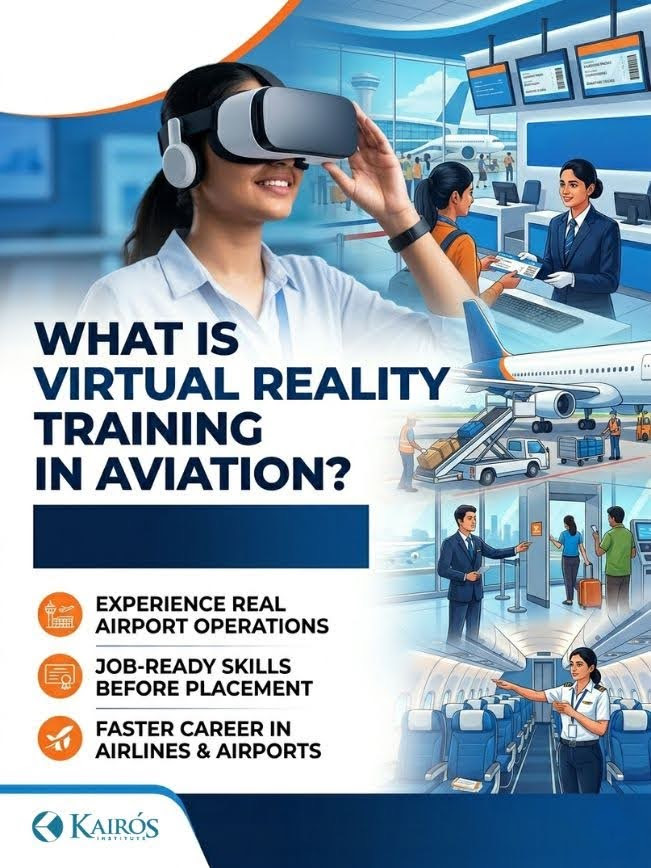
What Is Virtual Reality Training in Aviation? How Kairos Institute Uses VR for Student Learning
Read More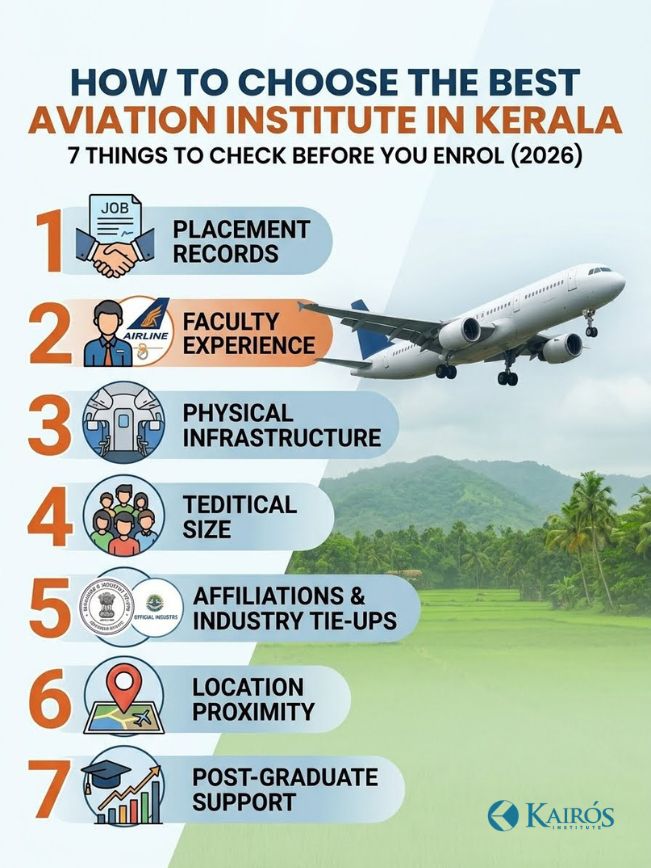
How to Choose the Best Aviation Institute in Kerala — 7 Things to Check Before You Enrol (2026)
Read More