
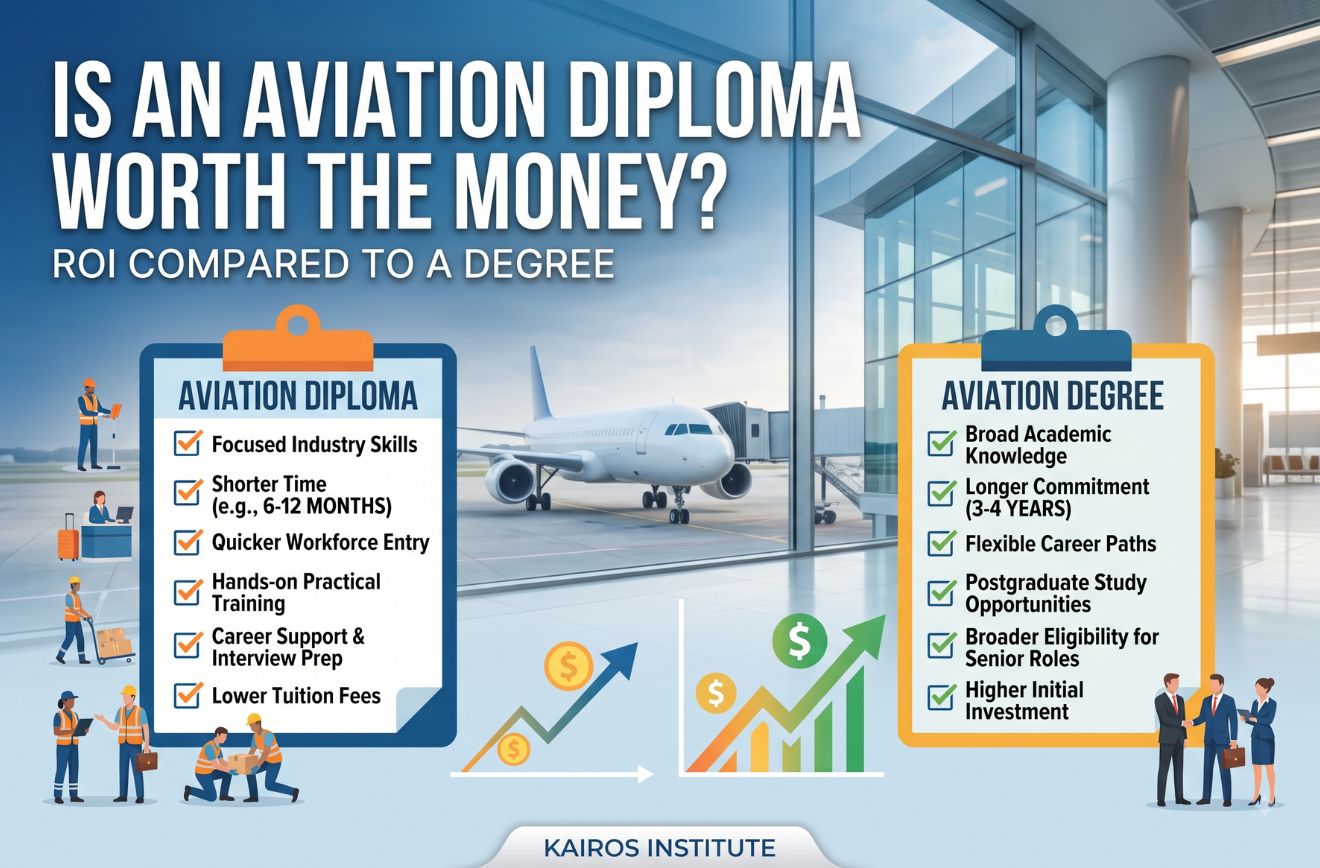
Is an Aviation Diploma Worth the Money? ROI Compared to a Degree
Admissions Started
Book your seat Now!
- AIRPORT MANAGEMENT
- LOGISTICS & SUPPLY CHAIN MANAGEMENT
- HOSPITAL ADMINISTRATION
- DIPLOMA & PG DIPLOMA
- 6 MONTHS & 1 YEAR
An aviation diploma costs less and takes less time than a degree, but "less" doesn't automatically mean "better value." Whether an aviation diploma is worth the money depends on what you're comparing it against, what career you actually want, and how you define return on investment. This article breaks that comparison down properly, instead of just putting fees side by side.
Is an Aviation Diploma Worth the Money?
For many students, yes, but only when the course matches their career goal and the investment is evaluated properly, not just by looking at the fee.
An aviation diploma tends to offer good value when a student wants focused, industry-relevant training that gets them into the workforce sooner, and when their target roles don't specifically require a degree. It tends to offer weaker value when a student picks it without checking whether their intended career actually needs broader academic qualifications, or when the course itself is weak on practical training and industry relevance.
The mistake most students make is comparing course fees against expected salary and stopping there. That comparison alone will not tell you whether a diploma or a degree is the better decision for you. You also need to account for time, opportunity cost, and what your specific target roles actually require.
What Does ROI Mean When Choosing an Aviation Course?
ROI (return on investment) in education is not a single number. It's a combination of four things:
Financial ROI: What you pay in fees and related costs, against what you can realistically expect to earn, and how quickly you start earning.
Time ROI: How long the course takes and what you give up by studying instead of working during that period. This is called opportunity cost, and it's usually the most ignored part of the calculation.
Career ROI: Whether the course actually builds skills and exposure that employers in aviation value, and whether it opens the door to entry-level roles you're interested in.
Qualification ROI: Whether the qualification is recognised for what you eventually want to do, including whether it keeps the door open for further study later.
A course with a lower fee isn't automatically better ROI if it takes just as long, teaches less that's industry-relevant, or closes doors you didn't know you needed open. Similarly, a more expensive degree isn't automatically better ROI if your target role never required it in the first place.
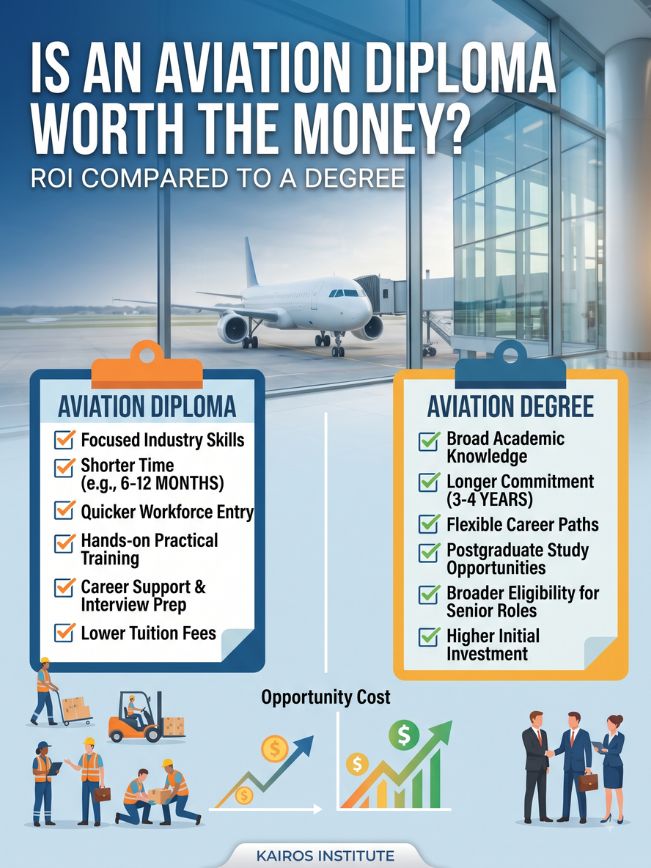
Aviation Diploma vs Degree: What's the Difference?
Factor | Aviation Diploma | Aviation Degree |
Study duration | Course-specific, generally shorter | Usually longer |
Academic depth | More focused on applied industry skills | Broader and typically deeper academically |
Practical orientation | Often built around operational, hands-on training | Varies by program and institution |
Entry into workforce | Can be quicker, depending on the course | Usually after the full degree period |
Career scope | Depends on the specific role and employer | Can open broader academic and professional pathways |
Further education | Depends on the qualification and its recognition | Generally provides broader eligibility for postgraduate study |
Best suited for | Students wanting focused, industry-ready preparation | Students wanting a broader undergraduate qualification |
Neither column is universally "better." They're built for different goals, and the right choice depends on what you're optimising for.
Aviation Diploma vs Degree: Which Has Better ROI?
This is where most comparisons go wrong by picking a winner. ROI depends on your specific goal.
Diploma ROI tends to be stronger when:
You have a clear, specific target, for example, ground operations, passenger services, or cargo support roles, that don't require a degree
You want to start earning sooner and reduce the time cost of education
You're confident in your interest in aviation and don't need years of broader academic exploration
The course you're choosing has strong practical training, communication development, and genuine industry relevance
Degree ROI tends to be stronger when:
Your long-term goal is a role that specifically requires or strongly prefers a degree (certain airline management, regulatory, or corporate aviation roles, for instance)
You want the flexibility to pivot into a different industry later, since a broader degree keeps more doors open
You're planning further academic study, like a postgraduate qualification, where degree-level entry is often required
You have the time and financial runway to invest 3+ years before entering full-time work
Neither path guarantees a specific salary or role. ROI is realised through what you do with the qualification — the skills you build, how you present yourself to employers, and how you handle the job search — not from the qualification alone.
What Jobs Can You Explore After an Aviation Diploma?
Career Area | Typical Work |
Passenger Services | Assisting travellers at terminals, check-in support, wayfinding |
Ground Operations | Ramp-area support, baggage-related coordination, liaison with ground crews |
Customer Service | Handling traveller queries and complaints |
Cargo Operations | Documentation support, warehouse coordination, freight movement processes |
Airline Support | Ground staff, ticketing/reservation support, airline customer service |
Airport Services | Operational and terminal-based service support |
These are common entry points, not guarantees. Every one of these roles is hired by a specific employer — an airline, a ground handling company, a cargo operator, or a terminal service provider — and each sets its own eligibility criteria around age, communication skills, and sometimes prior experience. A diploma prepares you for these roles; it doesn't automatically place you in one.
What Factors Affect the ROI of an Aviation Diploma?
The course itself matters more than the general category of "diploma." Two aviation diplomas can have very different ROI depending on:
Curriculum quality: whether it covers real airport operations knowledge or stays purely theoretical
Practical exposure: industrial visits, mock setups, or hands-on modules versus classroom-only learning
Communication training: spoken English and interview readiness, which consistently affects employability in this field
Faculty experience: instructors with actual industry background versus academic-only staff
Career guidance and placement support: whether the institute actively helps with resumes, interview prep, and job search, without promising guaranteed placement
Course duration: whether the time invested matches the depth of training you're getting
Location: proximity to aviation hubs can matter for internships and industry familiarity, though it isn't the deciding factor
Your own performance: communication skills, professionalism, and interview performance affect outcomes as much as the course itself
This is really the section that should guide your decision more than the diploma-vs-degree label. A weak diploma has poor ROI regardless of the category, and a strong diploma can outperform a mediocre degree for someone with a focused aviation goal.
Is a Degree Better for Long-Term Aviation Career Growth?
Sometimes, but it's not automatic. A degree can be advantageous when your long-term target role specifically lists a degree as a requirement, or when you're aiming for management, regulatory, or corporate-track positions where broader academic credentials are commonly expected.
That said, long-term career growth in aviation is driven by more than the initial qualification:
Experience gained in the role
Performance and reliability on the job
Additional certifications or specialisation taken up along the way
Communication and professional skills
The specific employer and how they structure promotions
A diploma does not automatically cap your career. Many professionals who start with focused, industry-specific training progress into supervisory or specialised roles based on performance and additional learning, not because they eventually "upgraded" to a degree. The qualification opens the entry point; what happens after that is largely up to the individual.
Who Should Choose an Aviation Diploma?
You have a specific interest in operational, ground-level, or passenger-facing aviation roles
You want to start working sooner rather than spending 3+ years in full-time study
You learn well through practical, applied training rather than broad academic study
Your budget and timeline favour a shorter, more focused investment
You're clear-eyed that career growth from here will depend on performance and continued learning, not the qualification alone
Who Should Choose an Aviation Degree?
Your target role explicitly requires or strongly prefers a degree-level qualification
You want to keep options open for postgraduate study or a possible industry switch later
You're comfortable with a longer study period and the associated cost
You want deeper academic grounding in aviation management, regulation, or business alongside operational knowledge
You're not yet fully certain which specific aviation career path you want, and prefer a broader qualification while you decide
How to Calculate the Real Cost of an Aviation Course
The course fee is only one line item. A realistic cost calculation includes:
Tuition and registration fees
Study materials and uniforms, where applicable
Travel to the institute, or relocation if studying away from home
Accommodation, if not living at home during the course
Time investment, months or years where you're not earning a full income
Opportunity cost, what you could have earned or learned by doing something else in that same period
Two courses with an identical tuition fee can have very different real costs once travel, accommodation, and time are factored in. Ask any institute for a full breakdown before comparing fees across options, and be wary of any number that isn't specific to the exact course and current intake you're evaluating.
What Should You Check Before Paying for an Aviation Course?
Use this as a working checklist before enrolling anywhere:
What exactly does the curriculum cover, and does it match your target career area?
What qualification is awarded at the end, and is it recognised for the roles you want?
What is the actual course duration, including any internship or practical component?
Is there hands-on or simulated practical training, not just classroom theory?
Does the course include real industry exposure, visits, guest sessions, or internships?
What is the faculty's actual industry background?
Does the institute offer career guidance, resume support, and interview preparation?
Are internship opportunities available, and are they part of the course structure?
Is the course/institute properly recognised or affiliated, where relevant to your goals?
What ongoing student support is available during and after the course?
Is the location workable for your commute, relocation, or proximity to the aviation hub you're targeting?
What is the total cost, including fees not listed in the headline number?
Not sure whether an aviation diploma or degree fits your career goal? Speak with the Kairos Institute team about your options.
Aviation Diploma at Kairos Institute
Kairos Institute runs aviation diploma programs from its branches in Bangalore, Kochi, and Thodupuzha, Kerala, built around airport operations knowledge, communication training, customer service, and professional etiquette- areas that consistently affect employability in aviation-support roles.
Students from Kerala targeting local aviation opportunities, or preparing for roles in aviation hubs like Bangalore, can choose the branch that fits their situation: training closer to home in Kochi or Thodupuzha, or training directly in the aviation courses in the Bangalore branch for early exposure to that market.
Kairos provides training and career guidance, resume support, interview preparation, and practical exposure, but does not place students directly into specific employers, and no training institute can guarantee a job. What a well-structured course can do is reduce the gap between where a student is now and what aviation employers are actually looking for.
Want to understand the aviation courses available at Kairos Institute? Contact the admissions team for course details and eligibility.
So, Is an Aviation Diploma Worth It?
An aviation diploma can be worth the investment when the course matches your career goal, provides genuinely relevant and practical training, and offers a realistic pathway into the aviation industry. A degree may be the better choice if you're aiming for a role that specifically requires one, want broader academic flexibility, or are planning further study down the line.
There's no universally correct answer between the two — only the answer that fits your target career, your timeline, and how much you're able to invest.
Planning an aviation career after 12th? Explore the aviation course options at Kairos Institute in Bangalore, Kochi, and Thodupuzha, Kerala, and choose a pathway that matches your career goals.
Frequently Asked Questions
Is an aviation diploma worth the money?
It can be, if the course is genuinely industry-relevant and matches a career goal that doesn't require a degree. It's not worth it if chosen without checking course quality or without a clear target role in mind.
Is an aviation diploma better than a degree?
Neither is universally better. A diploma suits focused, quicker entry into operational aviation roles; a degree suits students targeting roles that require one or who want broader academic flexibility.
Which is better after 12th: aviation diploma or degree?
It depends on your target career and timeline. Students wanting to enter the workforce sooner with practical, aviation-specific training often lean toward a diploma; students planning for degree-required roles or further study often choose a degree.
Can I get an airport job after an aviation diploma?
Yes, for many entry-level roles with airlines, ground handlers, cargo operators, and terminal service providers — but eligibility is set by each employer and specific vacancy, not guaranteed by the diploma itself.
Does an aviation diploma have good career scope?
It can, particularly in operational and passenger-facing roles, and career progression from there depends on performance, experience, and continued skill development.
Is an aviation degree necessary for airport jobs?
Not for most entry-level operational and passenger-facing roles. Some corporate, management, or regulatory-track roles do prefer or require a degree — this varies by employer and role.
How long does an aviation diploma take?
Duration varies by course and institute. Always check the exact duration for the specific program you're considering rather than assuming a standard length.
Is a degree better for long-term aviation career growth?
Sometimes, particularly for roles that specifically require one. But long-term growth is driven more by experience, performance, and additional skills than by the initial qualification alone.
What should I check before joining an aviation diploma course?
Curriculum relevance, practical training, faculty background, career guidance, placement support, total cost, and whether the qualification is recognised for the roles you want.
Can I pursue higher education after an aviation diploma?
This depends on the specific diploma and its recognition. Check with the institute whether it supports progression into further academic study if that's part of your long-term plan.
Does an aviation diploma guarantee a job? No qualification guarantees a job. It builds relevant skills and knowledge; actual hiring depends on the employer, the vacancy, and your own performance in the selection process.
Popular Blogs
Diploma in Airport Handling Course in Kochi, Kerala: Fees, Eligibility, Duration & Syllabus
Read More
Diploma in Warehouse Management Course in Kochi, Kerala: Fees, Eligibility, Duration & Syllabus
Read More
Diploma in Cabin Crew Management Course in Kochi, Kerala: Fees, Eligibility, Duration & Syllabus (2026)
Read More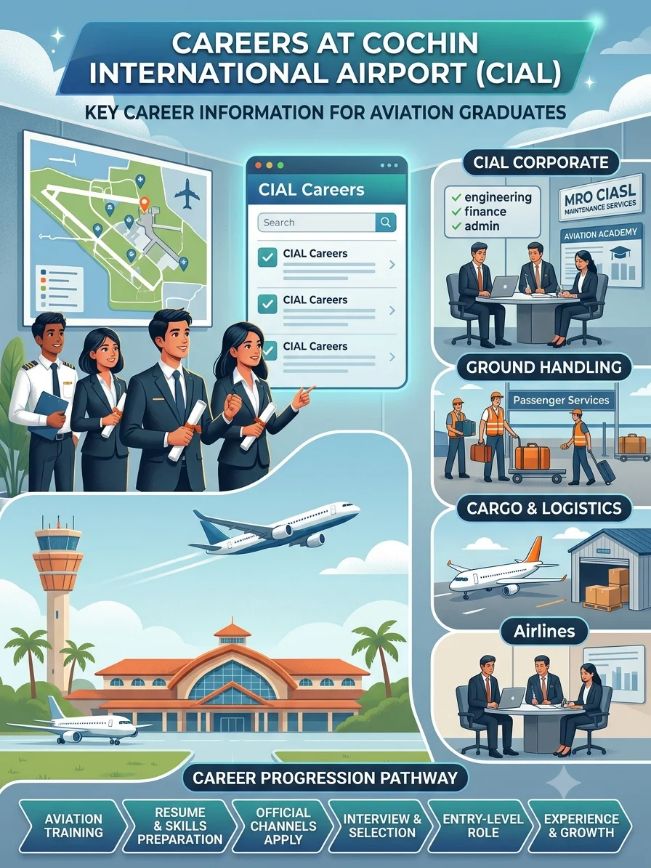



What Certifications Should Your Aviation Institute Have? A Complete Guide for Students and Parents in Kerala
Read More




How AI and Automation Are Changing Airport Jobs in 2026 — and What It Means for Your Career
Read More
What Is Virtual Reality Training in Aviation? How Kairos Institute Uses VR for Student Learning
Read More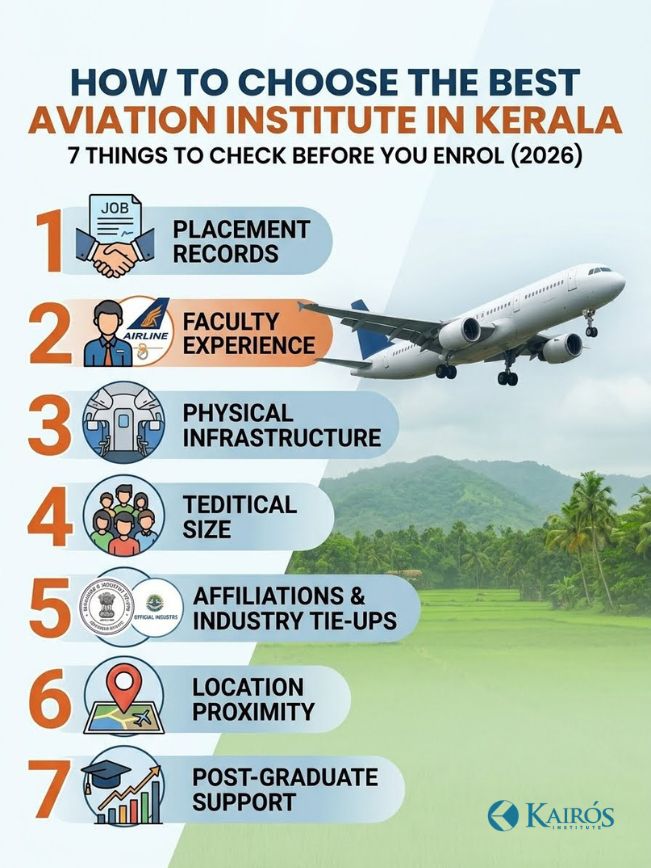
How to Choose the Best Aviation Institute in Kerala — 7 Things to Check Before You Enrol (2026)
Read More