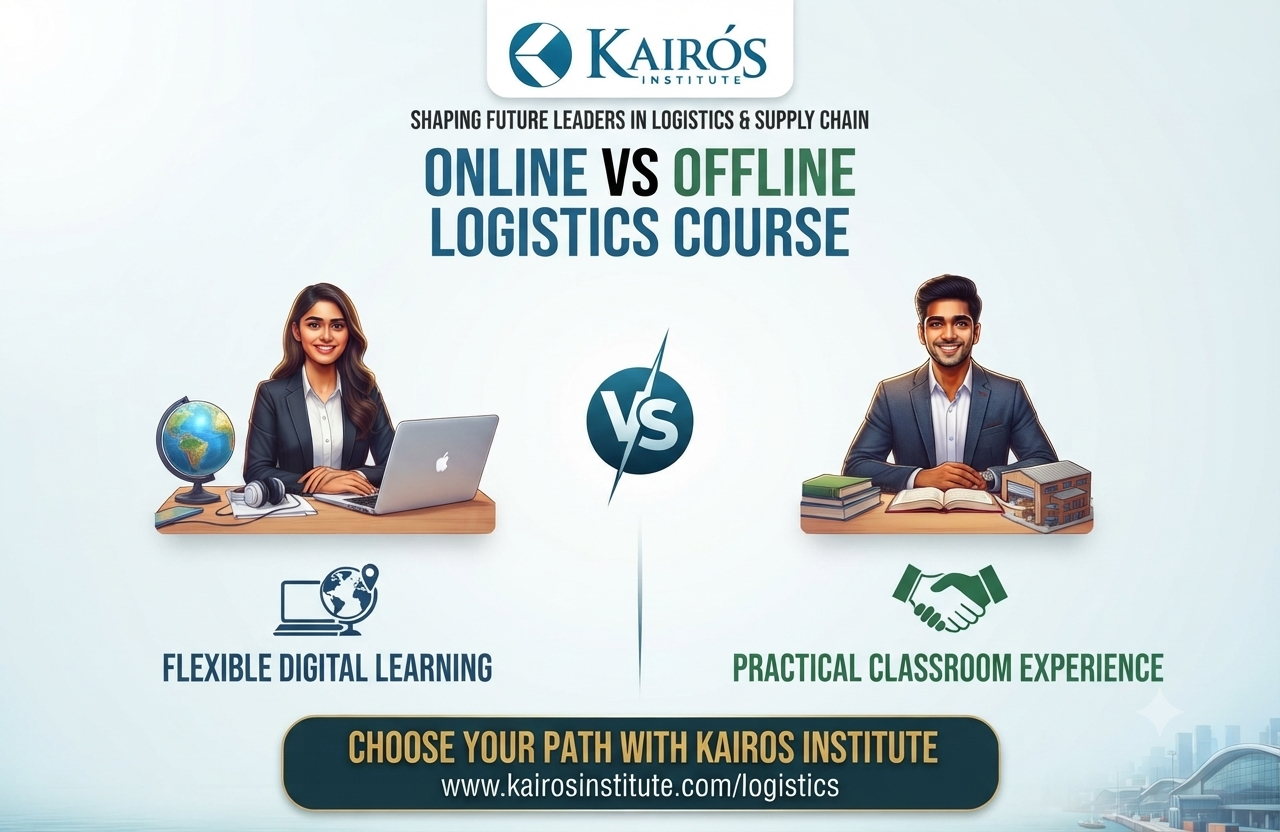
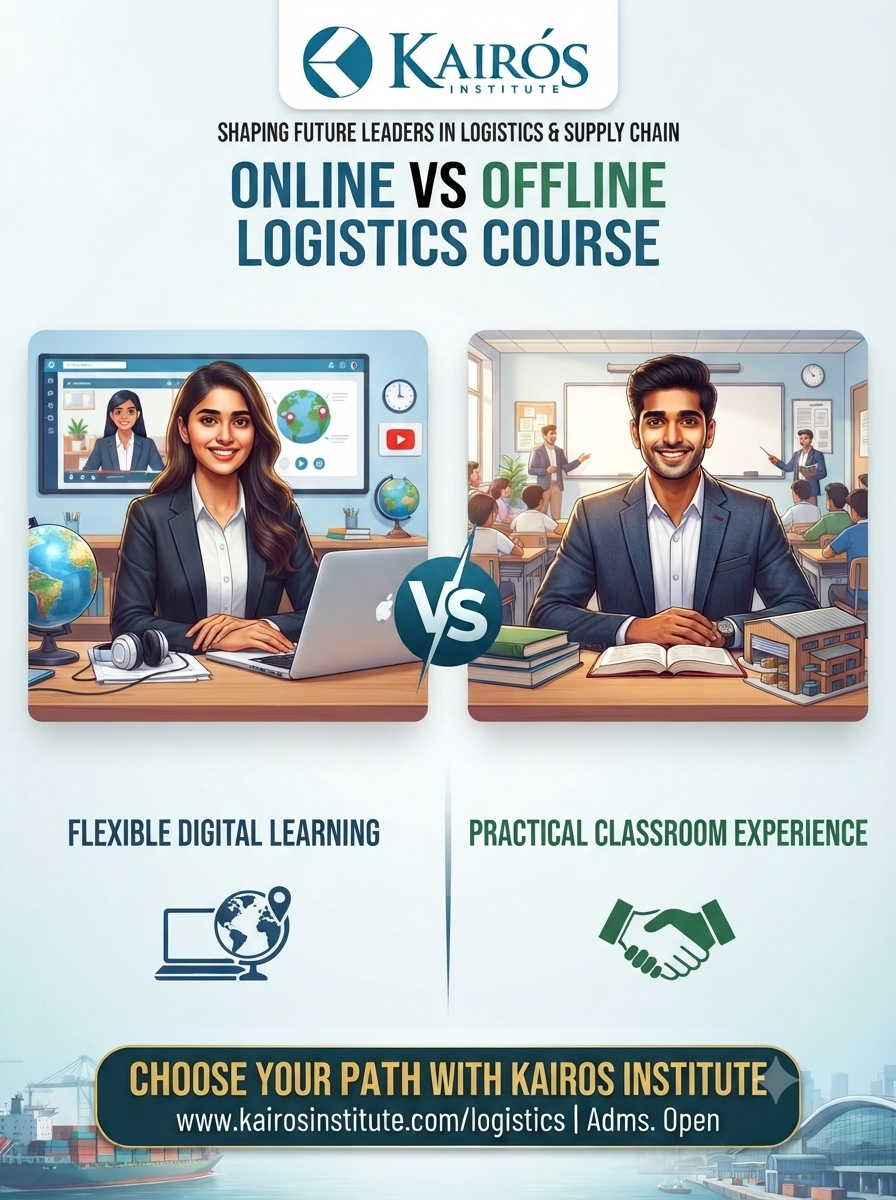
Neither an online nor an offline logistics course is better for everyone. An offline logistics course usually suits freshers, because it gives hands-on practice, live doubt clearing and industrial visits. An online logistics course suits working professionals and people who cannot travel daily, because it fits around their schedule. On recognition, what decides whether a certificate is accepted is who awards it and whether it is registered, not whether you studied online or in a classroom. This guide compares both modes and shows you how to check recognition yourself.
Online vs offline logistics course: quick comparison
The right mode depends on your stage of life, how you learn best and how much practical exposure you need.
Factor | Offline (classroom) | Online |
Practical training | Lab sessions, warehouse and port visits, mock operations in person | Software demos and simulations; site visits only if arranged separately |
Flexibility | Fixed timings and daily travel | Study from home, often with evening or weekend batches |
Doubt clearing | Instant, face to face | Live sessions or chat; depends on batch size and faculty access |
Discipline needed | Classroom routine keeps you on track | High self-discipline; easy to fall behind |
Soft skills and confidence | Group work, presentations and mock interviews in person | Possible on video, but less natural |
Networking | Classmates, faculty and visiting industry professionals | Mostly online, smaller peer contact |
Best for | Freshers, Plus Two and degree students, career starters | Working professionals, career changers, students far from a branch |
Who should choose an offline logistics course?
Choose offline if you are starting your career and need to become job-ready quickly. Logistics employers hiring freshers check whether you can handle real documents, systems and situations, and classroom training builds that faster.
Offline is usually the better fit if you:
Are a Plus Two student or a fresh graduate with no work experience
Learn best by doing, asking and watching others
Want warehouse, port or cargo terminal visits as part of the course
Need help building spoken English, interview confidence and workplace habits
For example, practicals in a Diploma in Warehouse Management, such as inventory handling, stock checks and warehouse layout, are much easier to understand when you see them in person.
Who should choose an online logistics course?
Choose online if you already work, live far from a training centre, or need to study around family responsibilities. Online study lets you build qualifications without leaving your job.
Online is usually the better fit if you:
Work full time in logistics, sales, retail or another field and want to switch or grow
Already understand basic workplace systems and need structured knowledge
Are disciplined enough to attend live sessions and finish assignments on time
Live outside Kochi, Thodupuzha or Bengaluru, or abroad
Is an online logistics course recognised in India?
An online logistics course can be recognised, but only if the certificate comes from a recognised awarding body. The study mode alone does not make a certificate valid or invalid.
In India, recognition works differently for degrees and skill certificates:
Degrees and PG diplomas from universities: The UGC has said that degrees and PG diplomas earned online or through distance learning from recognised higher education institutions are equivalent to those earned in regular mode, under its Open and Distance Learning and Online Programmes Regulations, as reported by Business Today in September 2022.
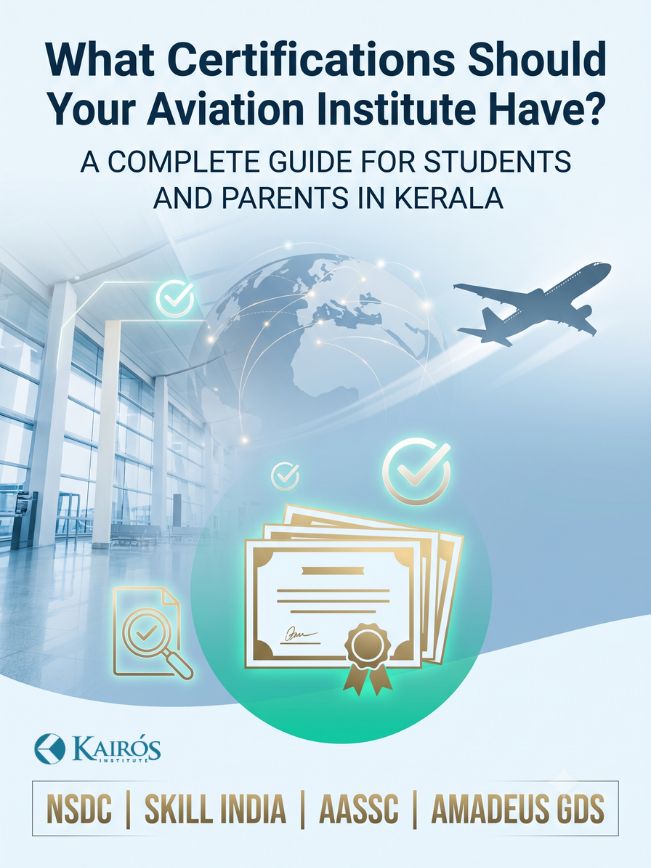
Skill diplomas and job-role certificates: Most logistics diplomas and certificates are skill qualifications, not university degrees. Recognised ones are aligned to the National Skills Qualifications Framework (NSQF) and listed on the National Qualifications Register (NQR), run by NCVET. In logistics, the awarding body is usually the Logistics Sector Skill Council.
One detail many students miss: each registered skill qualification states how it may be delivered. For example, the Logistics Sector Skill Council's "Logistics and Freight Forwarding" qualification on the NQR is approved for classroom delivery, with 340 of its 510 hours set as practical training. So check that the specific certificate you want is offered in the mode you choose.
How to check if a logistics certificate is recognised
Use these steps before paying for any logistics course, online or offline.
Ask for the exact certificate name. Find out who issues it: the institute, a sector skill council, a university or a software company.
Search the NQR. Look up the qualification on the National Qualifications Register to see its awarding body, NSQF level, hours and approved delivery mode.
Confirm the mode. Ask whether the online batch leads to the same certificate and assessment as the offline batch.
Check software certificates separately. Tool certificates such as SAP show you can use the software. They add to a skill qualification but do not replace it.
Ask about assessment. Find out whether assessment is online, in person, or a mix, and who conducts it.
Get it in writing. Ask for the course brochure or admission letter to name the certificate and the awarding body.
What employers look at besides the certificate
Employers in logistics rarely ask whether you studied online or offline. They ask what you can do. Expect interviews to test:
Basic export-import documents and logistics terms
Comfort with Excel and with warehouse or ERP software
Clear communication with clients, transporters and colleagues
Accuracy and the ability to follow procedures under deadlines
A recognised certificate gets your CV noticed. Practical skill and confidence get you the job. If you are planning to work in the Gulf, our article on logistics jobs abroad covers that path.
What you miss in an online course, and how to cover it
Online study saves time, but some parts of logistics are hard to learn on a screen. Plan for these gaps from the start.
No warehouse or port exposure: Ask whether the online batch includes any industrial visits, or arrange a short internship.
Less speaking practice: Turn your camera on, take part in role plays, and volunteer for presentations.
Software practice: Make sure you get hands-on access to the software, not only demonstrations.
Isolation: Join study groups and keep in touch with faculty for doubts and job leads.
Online and offline logistics training at Kairos Institute
Kairos Institute offers its Logistics and Supply Chain programme in both online and offline batches, as 6-month and 1-year diploma and PG diploma options. Offline batches run at Kochi (Kakkanad), Thodupuzha and Bengaluru (Koramangala), with industrial visits and classes led by industry professionals. Kairos works with the Logistics Skill Council, NSDC, Skill India and SAP as certification partners and offers placement assistance. See the full Logistics and Supply Chain course in Kerala for course options.
Frequently asked questions
Is an online logistics certificate accepted for jobs?
Yes, if it comes from a recognised awarding body such as a sector skill council or a recognised university. Employers focus on the issuing body and on your practical skills, not on whether you studied online. Check the qualification on the National Qualifications Register and be ready to show your skills in interviews.
Is an offline logistics course better for freshers?
Usually, yes. Freshers benefit from hands-on practice, face-to-face feedback, industrial visits and soft skills training, which are easier to deliver in a classroom. These help freshers who have never worked before become job-ready faster. Online can still work for disciplined freshers who add internships and practical exposure.
Can I do a logistics course online while working?
Yes. Online logistics courses are designed for people who need flexible timings, often with evening or weekend live sessions. Choose a course with recorded backups, hands-on software practice and the same certificate as the classroom batch. Plan fixed weekly study hours so that work does not push your learning aside.
What is the NSQF and why does it matter for logistics courses?
The National Skills Qualifications Framework (NSQF) is India's system for grading skill qualifications by level. Qualifications aligned to it are listed on the National Qualifications Register, run by NCVET. An NSQF-aligned logistics certificate shows that a recognised body has defined and assessed the job role.
Do online and offline students get the same certificate?
It depends on the institute and the qualification. Some certificates are awarded for both modes, while some registered skill qualifications are approved only for classroom delivery. Ask the institute in writing whether your batch leads to the same certificate and assessment, and check the qualification's delivery mode on the NQR.
Still deciding between online and offline?
A short conversation can help you pick the mode that fits your goals, schedule and current experience. Book a free counselling call with a Kairos counsellor on WhatsApp or phone at +91 80 780 290 50. Working professionals can ask about online batch timings.
Visit us
You can also contact us to visit our Kochi (Kakkanad), Thodupuzha or Bengaluru (Koramangala) branch and see the classroom training for yourself.
Kochi: Kairos Institute, Door No.3060, Divine Park Layout Road, Kakkanad, Ernakulam, Kerala 682037 (view on Google Maps)
Thodupuzha: Kalarickal Bazar, Near Private Bus Stand, Thodupuzha, Idukki, Kerala 685584 (get directions)
Bengaluru: #A7, KHB Colony, 5th Block, Koramangala, Bengaluru, Karnataka 560095 (find us on Google Maps)