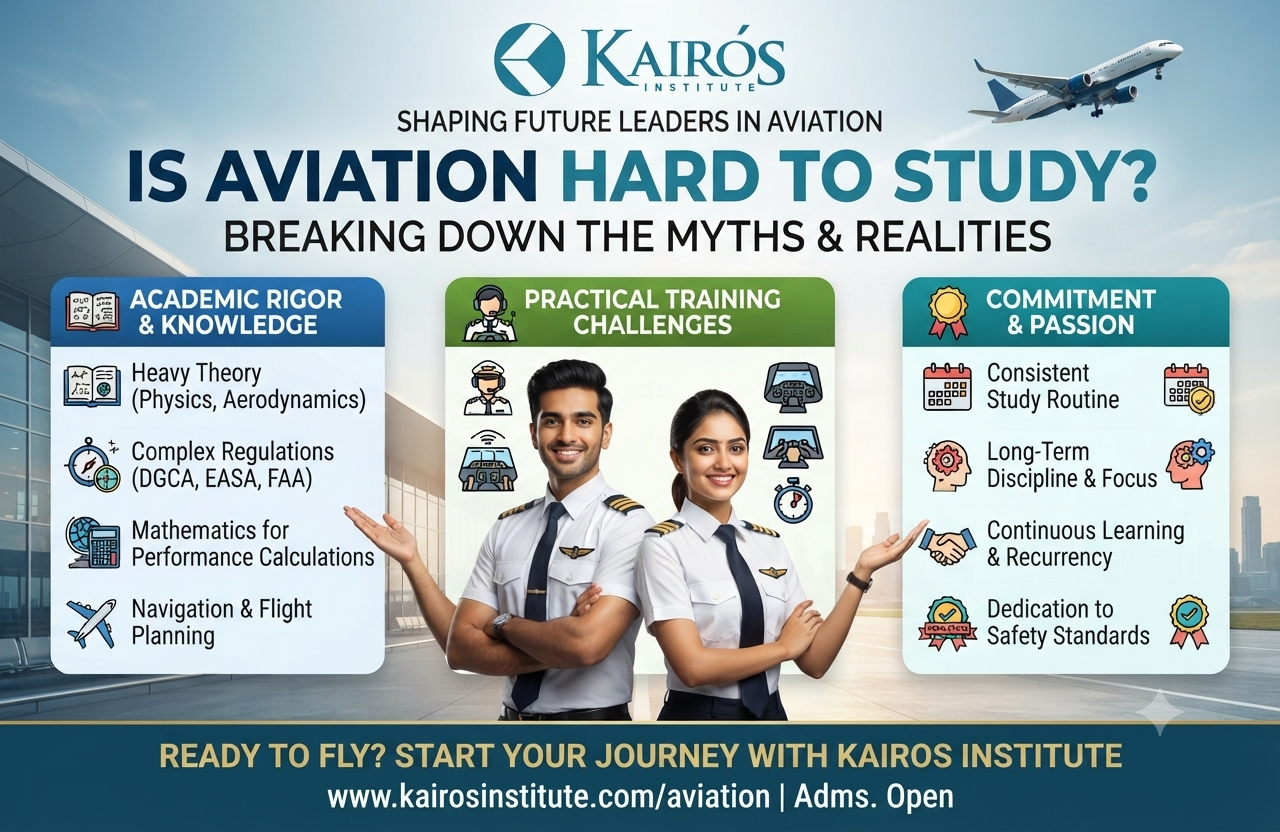
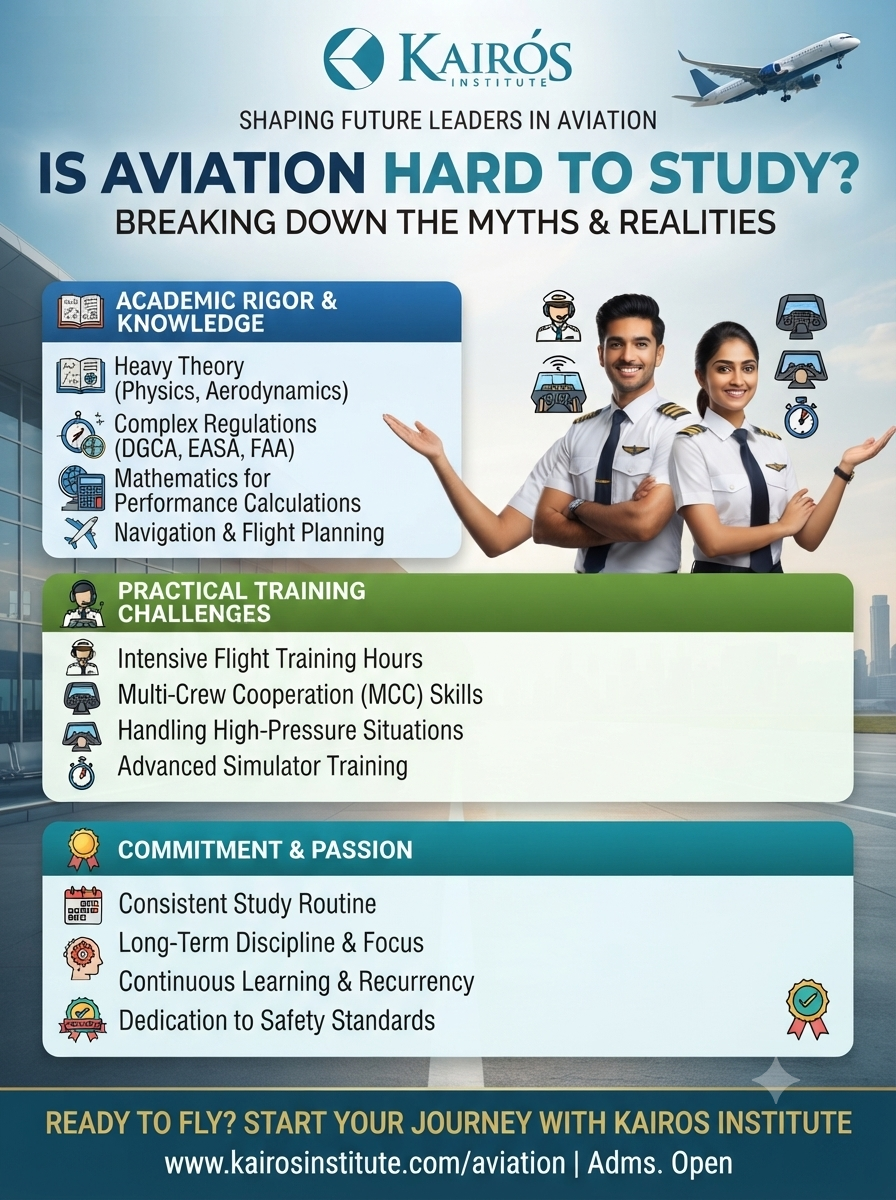
Aviation management courses, such as airline and airport management, cabin crew and ticketing, are not hard to study in the academic sense. They involve little maths and no heavy theory. What students find challenging is the practical side: speaking confidently in English, keeping up professional grooming, learning airline codes and following strict routines. All of these can be learned with regular practice. Pilot training and aircraft engineering are different, and much more demanding, and we explain that difference below.
What you actually study in an aviation course
Aviation management courses train you to work in airports, airlines and travel companies, not to fly or repair aircraft. Most of the learning is practical and job-focused.
Typical areas include:
Airport and airline operations: check-in, boarding, baggage handling, ground handling and how an airport works day to day
Customer service and communication: handling passengers, announcements, complaints and difficult situations politely
Ticketing and reservations: fares, routes and booking systems such as the Amadeus global distribution system (GDS)
Safety and emergency procedures: especially in cabin crew training
Grooming, etiquette and personality development: how you look, speak and carry yourself at work
For most students, this feels closer to skill training than to school exams. You learn by doing role plays, mock check-ins, presentations and practical sessions.
How hard is each aviation course?
Difficulty depends on the course and on your own strengths. The table below is a general guide based on what each course demands, not a ranking of which is better.
If you are choosing between cabin and airport roles, our guide to ground staff vs cabin crew compares the two careers in detail.
Do you need maths or science for aviation courses?
Aviation management courses do not depend on maths or science. Students from arts, commerce and science streams all join and do well. You will use simple arithmetic for fares, baggage weight or time zones, but nothing beyond school level.
Entry requirements vary by course and level, so confirm the eligibility for your chosen course with the institute before applying.
What students find difficult (and how to handle it)
These are the areas that new aviation students most often say feel hard at first. None of them needs top marks, only steady effort.
1. Speaking English confidently
Many students from Malayalam-medium schools worry about English. The aviation industry needs clear, polite spoken English more than perfect grammar. How to cope: speak English in class every day, watch airline announcements and repeat them aloud, and practise passenger role plays with friends.
2. Grooming and discipline
Airlines expect neat uniforms, tidy hair, punctuality and good posture every single day. This feels strict at first, especially for students coming straight from school. How to cope: treat class days as work days and build the routine early.
3. Airline codes and ticketing systems
Airport codes such as COK (Kochi) and BLR (Bengaluru), airline codes and GDS commands can feel like a new language. How to cope: learn a few codes each day, use flashcards, and practise on the system in lab sessions rather than only reading notes.
4. Confidence in front of people
Shy students sometimes find presentations, mock interviews and customer role plays stressful. How to cope: start small, volunteer for short tasks, and remember that confidence grows with practice. Many quiet students become comfortable within a few months.
5. Adjusting to real airport conditions
Airports are busy and loud, and work can mean early mornings or night shifts. How to cope: use industrial visits and simulated airport training to get used to the environment before your first job.
Aviation management vs pilot training: why they are not the same
When people say aviation is hard, they often mean becoming a pilot or an aircraft maintenance engineer. Those are very different paths.
Pilot training for a Commercial Pilot Licence (CPL) is regulated by India's Directorate General of Civil Aviation (DGCA). It needs strict medical fitness, technical ground exams in subjects like navigation and meteorology, and logged flying hours. It also costs far more and takes longer than a management diploma. Science eligibility for pilot training has been under review: in May 2025 Business Standard reported that DGCA had proposed opening it to students from any Class 12 stream, pending government notification. Check DGCA for the current rule.
Aircraft maintenance engineering is also technical and science-based. If you want a job in the aviation industry without that level of technical study, management and airport courses are the more accessible route.
How good training makes aviation easier to learn
The right teaching approach makes a big difference to how hard a course feels. Look for training that is practical, regular and close to real work.
At Kairos Institute, aviation students learn through gamified classes, sessions with industry professionals and industrial visits. Our VR airport training (Airportverse) lets students practise airport situations before they face them for real. Classes run in Kochi (Kakkanad), Thodupuzha and Bengaluru (Koramangala), in online and offline batches. You can see all our aviation courses in Kerala in one place.
Frequently asked questions
Can an average student do an aviation course?
Yes. Aviation management courses reward regular practice, communication and discipline more than exam scores. Average students often do well because the learning is practical, with role plays, lab sessions and mock interviews. What matters most is attending regularly, practising English and building professional habits from the first week.
I am weak in English. Can I still study aviation?
Yes, if you are willing to practise. Most aviation courses include communication and personality development training, and spoken English improves quickly with daily use in class. Airlines look for clear, polite communication rather than perfect grammar. Start practising now by reading aloud and speaking English with friends.
Is cabin crew training harder than ground staff training?
Neither is harder overall; they are hard in different ways. Cabin crew training puts more weight on grooming, fitness, safety drills and confidence. Ground staff and airport courses put more weight on procedures, systems and teamwork. Choose the one that matches your personality and strengths.
Should I choose a diploma or a degree if I worry about difficulty?
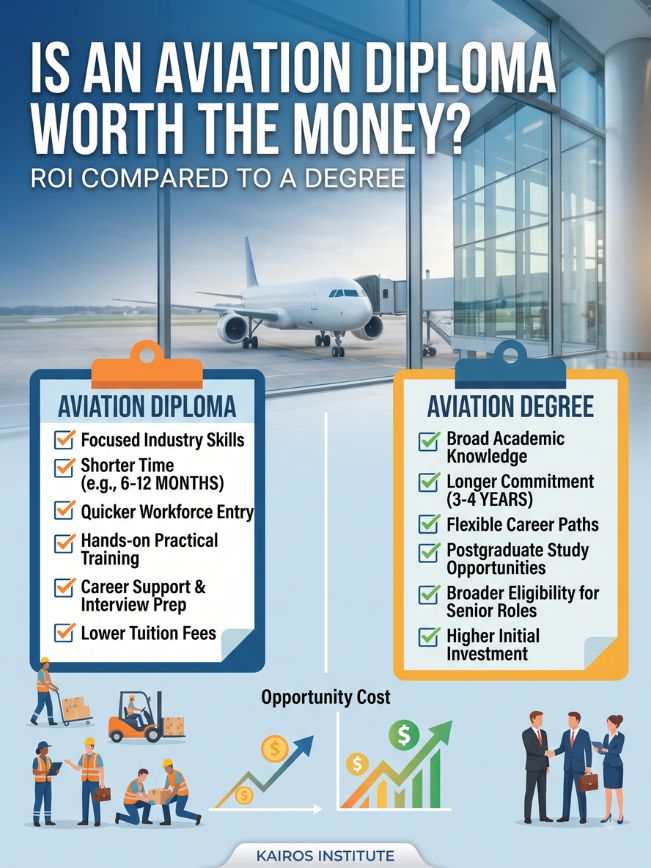
A diploma is shorter and fully job-focused, so many students find it easier to manage. A BBA with Aviation takes longer and includes business subjects, which suits students who want a degree. Our article on whether an aviation diploma is worth it compared with a degree explains the trade-offs.
How many hours a day should I study for an aviation course?
There is no fixed number. Most of the learning happens in class through practicals. Spending 30 to 60 minutes a day revising codes, practising English and preparing for presentations is usually enough to keep up. Consistency matters more than long study sessions before exams.
Not sure if aviation suits you?
Talking it through can make the decision easier for both you and your parents. Book a free counselling call with a Kairos counsellor on WhatsApp or phone at +91 80 780 290 50.
Visit us
You can also contact us to visit our Kochi (Kakkanad), Thodupuzha or Bengaluru (Koramangala) branch. We will help you check which course fits your strengths before you decide.
Kochi: Kairos Institute, Door No.3060, Divine Park Layout Road, Kakkanad, Ernakulam, Kerala 682037 (view on Google Maps)
Thodupuzha: Kalarickal Bazar, Near Private Bus Stand, Thodupuzha, Idukki, Kerala 685584 (get directions)
Bengaluru: #A7, KHB Colony, 5th Block, Koramangala, Bengaluru, Karnataka 560095 (find us on Google Maps)