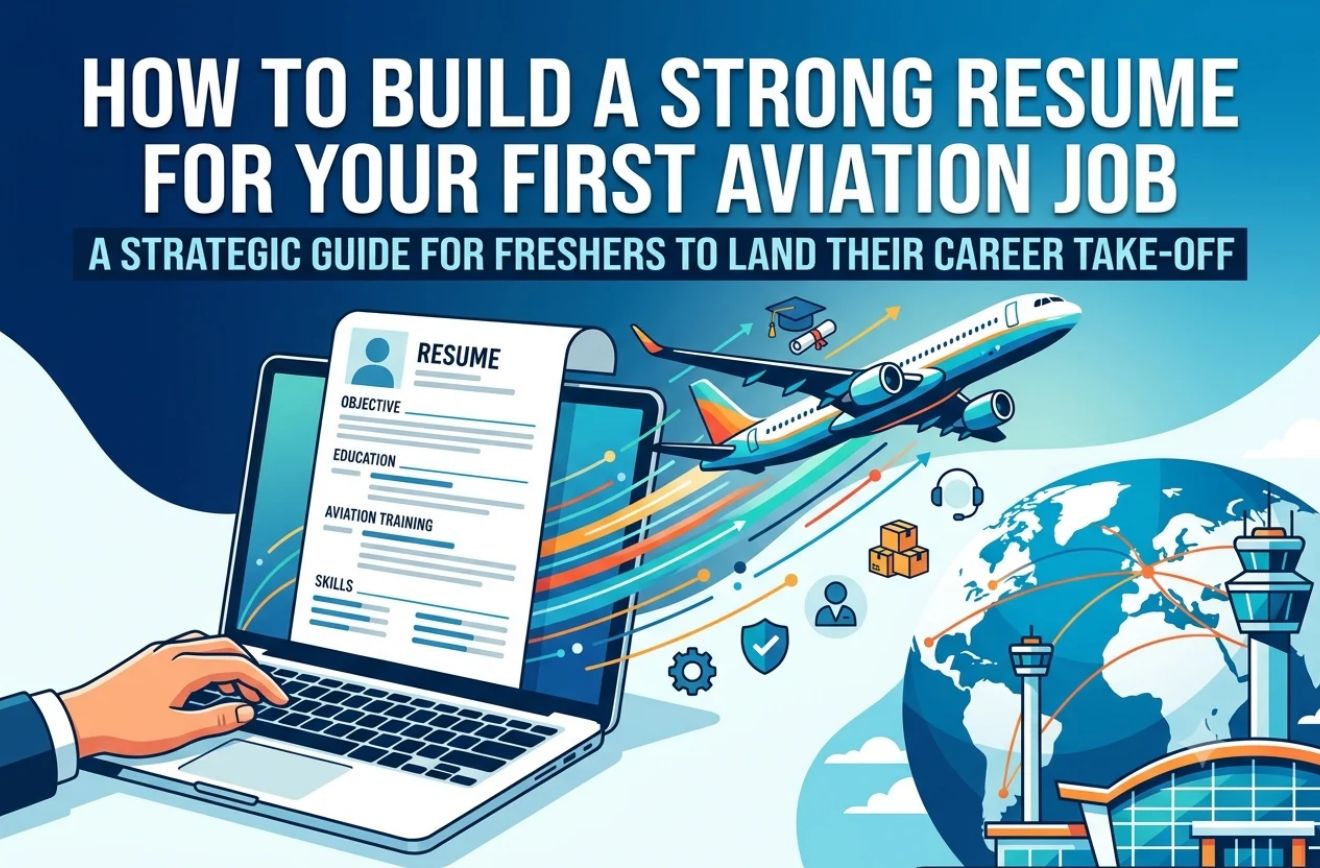
How to Build a Strong Resume for Your First Aviation Job
Admissions Started
Book your seat Now!
- AIRPORT MANAGEMENT
- LOGISTICS & SUPPLY CHAIN MANAGEMENT
- HOSPITAL ADMINISTRATION
- DIPLOMA & PG DIPLOMA
- 6 MONTHS & 1 YEAR
An aviation resume for freshers has one job to do: show a recruiter, in under 30 seconds, that you understand the role you're applying for and have something relevant to bring to it. That's a different challenge from a generic fresher resume, and this guide walks through exactly how to build one, section by section, role by role.
What Makes an Aviation Resume Different From a Regular Fresher Resume?
A generic fresher resume tends to list education and a broad set of soft skills. An aviation resume needs to do more specific work, because aviation roles are customer-facing, operationally structured, and often assessed against very particular criteria, communication ability, grooming, operational awareness, and role-specific knowledge (check-in processes, passenger handling, cargo documentation, ticketing systems, depending on the job).
This means your resume should:
Point clearly to a specific aviation job category, not "any suitable role"
Use terminology recruiters in that category actually recognise
Show evidence of aviation-relevant preparation, even without formal work experience
Present skills in the context of passenger or operational scenarios, not as an abstract list
What Should an Aviation Fresher Put on a Resume?
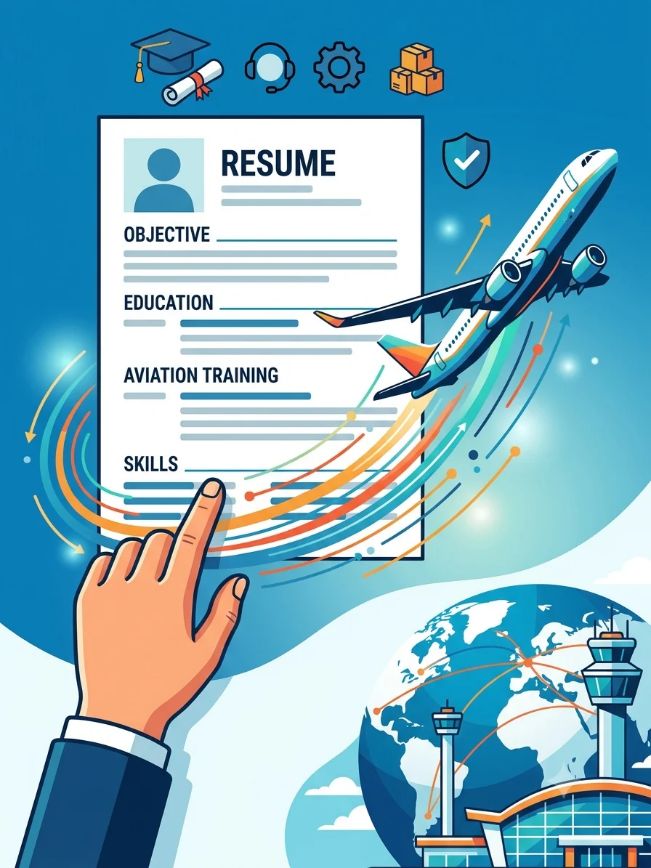
A focused, one-page structure works best for most freshers. Not every section below is mandatory, include what's genuinely relevant.
Name and contact details: phone, professional email, city
Career objective/summary: 2–3 lines, role-specific (see next section)
Education: 12th standard, degree if applicable, with institution and year
Aviation training/certifications: diploma, short courses, relevant certifications
Relevant skills: role-mapped, not a generic list
Internship/practical training: industrial visits, mock operations, on-the-job exposure during your course
Academic projects: if directly relevant (e.g., a project on airport operations or customer service)
Achievements: genuine, specific, and relevant
Languages: especially useful for passenger-facing roles
Additional information: only if it adds real value (e.g., willingness to relocate or work shifts)
Skip sections that would only pad the page. A tight, relevant one-pager reads better than a padded two-pager.
How to Write an Aviation Resume Objective
Your objective should communicate four things in two to three lines: who you are, your qualification, your relevant skills, and the specific role you're targeting.
Avoid generic lines like "Seeking a challenging position in a reputed organisation where I can utilise my skills." This tells a recruiter nothing about you or the role.
Instead, be specific to the job category. For example:
For a passenger service/airline customer service role: "Aviation diploma holder with training in passenger handling, communication, and customer service, seeking an entry-level airline customer service role where I can apply my training in a passenger-facing environment."
For a ground operations role: "12th-pass candidate with a Diploma in Airline & Airport Management, trained in airport operations and ground coordination, looking to start a career in ground handling with a focus on operational accuracy and teamwork."
For a cargo/logistics-focused role: "Graduate with training in air cargo documentation and logistics coordination, seeking an entry-level position in cargo operations to apply my knowledge of freight handling and airway bill processing."
Each version points to a different role and uses that role's language — this is the single biggest difference between a strong and a weak aviation resume objective.
How to Show Aviation Skills When You Have No Work Experience
No full-time job experience does not mean you have nothing relevant to show. Freshers can genuinely draw on:
Aviation training or diploma coursework, specific modules, not just the course title
Internships or industrial visits completed during your course
Academic or practical projects related to aviation, customer service, or operations
College responsibilities, event coordination, student council roles, front-desk or reception duties
Part-time or volunteer work involving customer interaction, even outside aviation
Communication-heavy roles, tutoring, retail, hospitality, or similar public-facing work
What you should never do is add fake aviation experience, invented internships, or skills you don't actually have, just to fill the resume. Recruiters ask follow-up questions specifically to test this, and it undermines your credibility immediately if the details don't hold up.
Best Skills to Include on an Aviation Resume
Rather than listing 20–30 generic skills, match them to the role you're applying for.
Target Role | Relevant Skills | Why It Matters |
Passenger Service | Communication, customer service, problem-solving | Direct, constant interaction with travellers |
Ground Operations | Teamwork, coordination, operational awareness | Work involves multiple teams and time-sensitive tasks |
Airport Customer Service | Communication, complaint handling, professionalism | Frequent handling of queries and service issues |
Cargo/Logistics | Documentation, organisation, coordination | Accuracy in freight and paperwork is critical |
Airline Support Roles | Computer skills, communication, teamwork | Involves systems, coordination, and passenger contact |
Pick 5–7 skills genuinely relevant to your target role rather than listing everything you can think of, a long, unfocused list reads as padding, not strength.
How to Tailor Your Resume for Different Aviation Jobs
The same candidate, with the same training, should adjust their resume depending on the role:
Airline Customer Service: Lead with communication, passenger assistance, customer service, problem-solving, and professional etiquette.
Ground Operations: Lead with teamwork, coordination, operational awareness, and time management.
Airport Operations: Lead with operations knowledge, documentation accuracy, coordination, and computer skills.
Cargo/Logistics: Lead with documentation, organisation, logistics knowledge, and any inventory or coordination exposure.
If you're applying to more than one type of role, keep two or three tailored versions of your resume rather than sending one generic version everywhere.
How to Make an Aviation Resume ATS-Friendly
Many recruiters, particularly larger airlines and ground handling companies, use Applicant Tracking Systems (ATS) to screen resumes before a human reviews them. Practices vary by employer, but a few habits generally help:
Use clear, standard section headings (Education, Skills, Training) rather than creative labels
Use terminology that matches how the industry actually describes the role
Keep formatting simple, avoid text inside images, heavy graphics, or complex tables in the main content
Use a readable, standard font
Save as PDF unless the employer specifically requests another format
Note that ATS optimisation improves your resume's chances of being read correctly, it doesn't guarantee shortlisting. The final decision still depends on the recruiter and the specific role requirements.
Truthful Keyword Use
If a job listing mentions "passenger handling" and you genuinely have relevant training or exposure, use that exact phrase, it helps both ATS matching and human readability. But if you don't actually have a skill the listing mentions, don't claim it just because the words appear in the vacancy. Recruiters in aviation often probe specific claims directly in interviews, and a mismatch between your resume and your actual knowledge is one of the fastest ways to lose credibility.
Aviation Fresher Resume Format: Example
Here's a sample structure using a fictional candidate, to show how the sections come together for a ground operations application:
Anjali Menon +91-XXXXXXXXXX | anjali.menon@email.com | Kochi, Kerala
Career Objective Aviation diploma holder trained in airport operations and ground coordination, seeking an entry-level ground operations role to apply my training in a fast-paced, team-based airport environment.
Education Higher Secondary (Plus Two), Commerce [Board name], 2025 Diploma in Airline & Airport Management [Institute name], 2025–2026
Aviation Training
Modules covered: airport operations, ground handling procedures, passenger service fundamentals, aviation terminology
Practical exposure through mock airport setup and industrial visit to [Airport name]
Relevant Skills Teamwork, coordination, communication, basic computer proficiency, time management, professional grooming
Practical Training Two-week industrial exposure observing check-in and ground coordination processes at [Airport name] as part of diploma coursework
Languages English, Malayalam, Hindi (working proficiency)
Achievements Coordinated a college event involving over 200 attendees, managing logistics and on-ground coordination for the day
Adjust the objective, skills, and training sections for other role types using the same structure.
Common Aviation Resume Mistakes Freshers Should Avoid
Using a generic, role-less objective statement
Not naming a specific target role anywhere on the resume
Filling space with irrelevant information instead of relevant, if limited, experience
Leaving out aviation training or coursework details
Stuffing keywords from a job listing without genuine relevance
Adding fake experience or unearned skills
Poor formatting, inconsistent spacing, cluttered layout, hard-to-scan structure
Grammar and spelling errors
Using an unprofessional email address
Overly decorative, aviation-themed templates that reduce readability
How to Prepare Your Resume for an Airport Job Interview
Everything on your resume is fair game for interview questions. If you've listed a specific training module, a project, or a responsibility, be ready to explain it clearly, what you did, what you learned, and how it connects to the role you're applying for. This is also a good reason not to overstate anything: an interviewer's first few questions often test whether the resume reflects reality.
Can Aviation Training Improve Your Resume?
Relevant training can genuinely strengthen a fresher resume by adding structured industry knowledge, operational understanding, communication and customer-service preparation, and content you can speak to confidently in an interview. It gives you specific, real material to include instead of generic soft-skill claims.
What it doesn't do is guarantee that a resume gets shortlisted or that an interview leads to a job offer, that still depends on the employer, the specific vacancy, and how you perform through the selection process.
Aviation Training at Kairos Institute
Kairos Institute has branches in Kochi, Thodupuzha, and Bangalore, offering programs relevant to different aviation career tracks, including the Diploma in Airline & Airport Management for ground and airport-operations-focused roles, the Diploma in Cabin Crew Management for onboard service careers, the Diploma in Air Fare & Ticketing Management for reservation and ticketing-focused roles, and the Diploma in Air Cargo Management for students interested in cargo and logistics.
These programs are built to give students exactly the kind of material this article recommends including on a resume, structured training, practical exposure, and role-specific knowledge. The connection here is training → skills → resume content → interview readiness, not training → guaranteed job.
If you are unsure which aviation skills employers expect, speak with Kairos Institute about the training options that match your career goal.
Resume Checklist Before Applying for Your First Aviation Job
Target job identified
Contact information correct and current
Professional email address
Career objective customised to the specific role
Education included with clear dates
Aviation training/diploma included with relevant modules
Skills mapped to the target role, not generic
Practical exposure or projects included honestly
No fake experience or unearned skills
Job-description keywords matched truthfully
Grammar and spelling checked
Formatting consistent and easy to scan
File saved as PDF (unless employer specifies otherwise)
File named professionally (e.g., "Anjali_Menon_Resume.pdf")
Employer's specific application instructions followed
Ready to prepare for your first aviation job? Explore aviation training and career preparation options at Kairos Institute.
Final Thoughts: Your Aviation Resume Should Show Career Readiness
A strong aviation fresher resume doesn't need years of experience. It needs to clearly show relevant education, skills, training, honest practical exposure, and a genuine understanding of the specific role you're applying for. Get those elements right, and a one-page resume can do more work than a padded, generic one ever could.
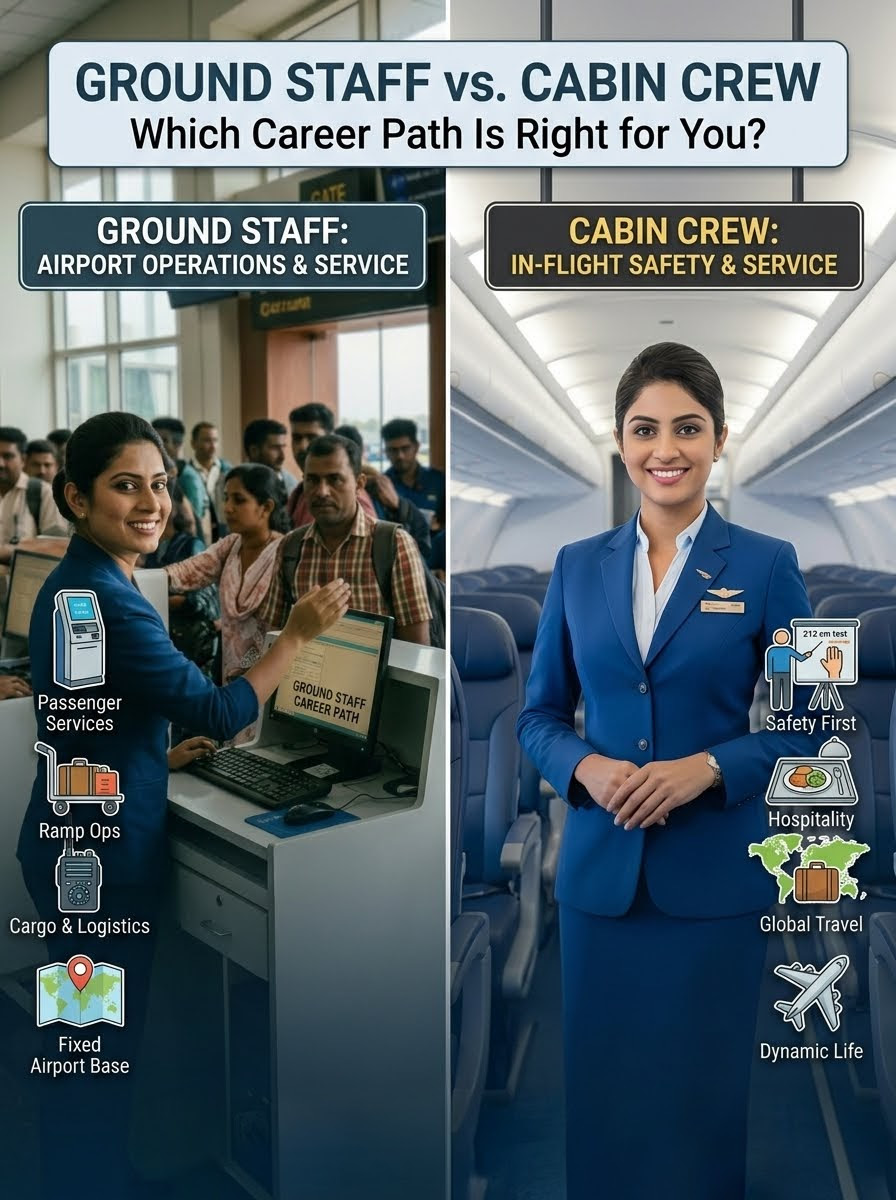
For related career preparation, see our guides on Ground Staff vs Cabin Crew: Which Career Path Is Right for You? and How to Get a Job as Ground Staff in an Airport.
Frequently Asked Questions
How do I write an aviation resume as a fresher?
Focus on a role-specific objective, your education, aviation training, relevant skills mapped to the target job, and any practical exposure, kept to one clear, well-formatted page.
What should I include in an aviation resume?
Contact details, a role-specific objective, education, aviation training/certifications, relevant skills, practical exposure or projects, languages, and genuine achievements.
What skills should I put on an aviation resume?
Skills relevant to your target role, for example, communication and customer service for passenger-facing roles, or coordination and documentation for cargo/logistics roles.
What should a fresher write in an aviation resume objective?
A 2–3 line statement naming your qualification, relevant skills, and the specific aviation role you're targeting, avoid generic, role-less statements.
How long should an aviation fresher resume be?
One page is usually sufficient for freshers; focus on relevance over length.
Can I apply for airport jobs without experience?
Yes, many entry-level aviation roles accept freshers. Highlight training, practical exposure, and transferable skills instead of formal work experience.
How can I show aviation experience if I am a fresher?
Use aviation training, internships, industrial visits, academic projects, and relevant transferable experience, presented honestly, without fabrication.
Should I include an aviation diploma on my resume?
Yes, along with the specific modules or training areas covered, since this gives recruiters concrete, relevant detail beyond just the course title.
How do I make an aviation resume ATS-friendly?
Use clear standard headings, industry-appropriate terminology, simple formatting, and a readable font, and save as PDF unless told otherwise.
What skills should I highlight for airport customer service jobs?
Communication, customer service, complaint handling, and professional presentation.
What should a ground staff resume include?
Teamwork, coordination, operational awareness, relevant training, and any practical exposure to airport operations.
Can aviation training help improve my resume? Yes, it adds structured knowledge and real content to reference, though it doesn't guarantee shortlisting or a job offer on its own.
Planning your first aviation career? Contact Kairos Institute in Kochi, Thodupuzha, or Bangalore to explore aviation courses and career preparation options.
Popular Blogs
What Certifications Should Your Aviation Institute Have? A Complete Guide for Students and Parents in Kerala
Read More


How AI and Automation Are Changing Airport Jobs in 2026 — and What It Means for Your Career
Read More
What Is Virtual Reality Training in Aviation? How Kairos Institute Uses VR for Student Learning
Read More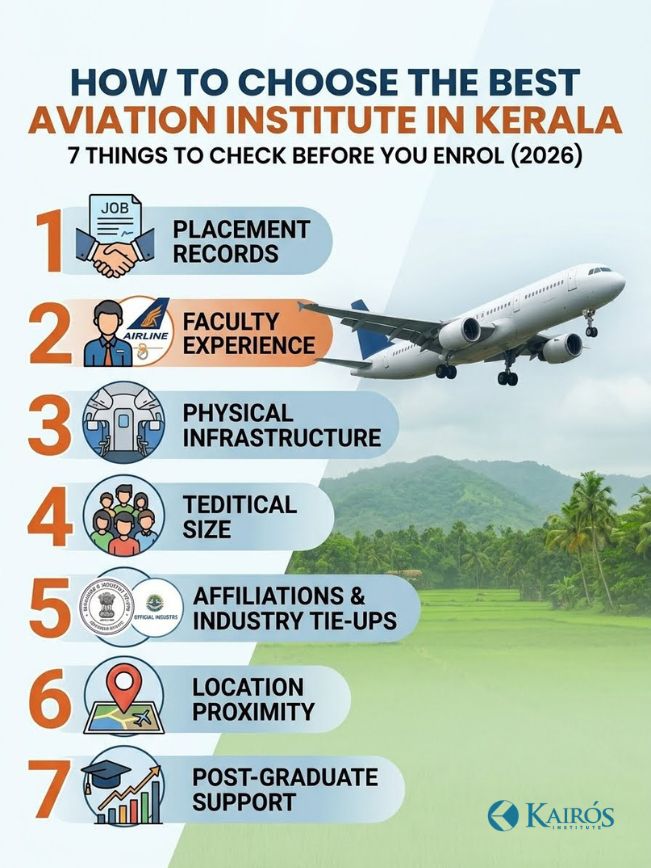
How to Choose the Best Aviation Institute in Kerala — 7 Things to Check Before You Enrol (2026)
Read More